Meeting Talkative Mr. Adjective: The Words That Paint a Picture
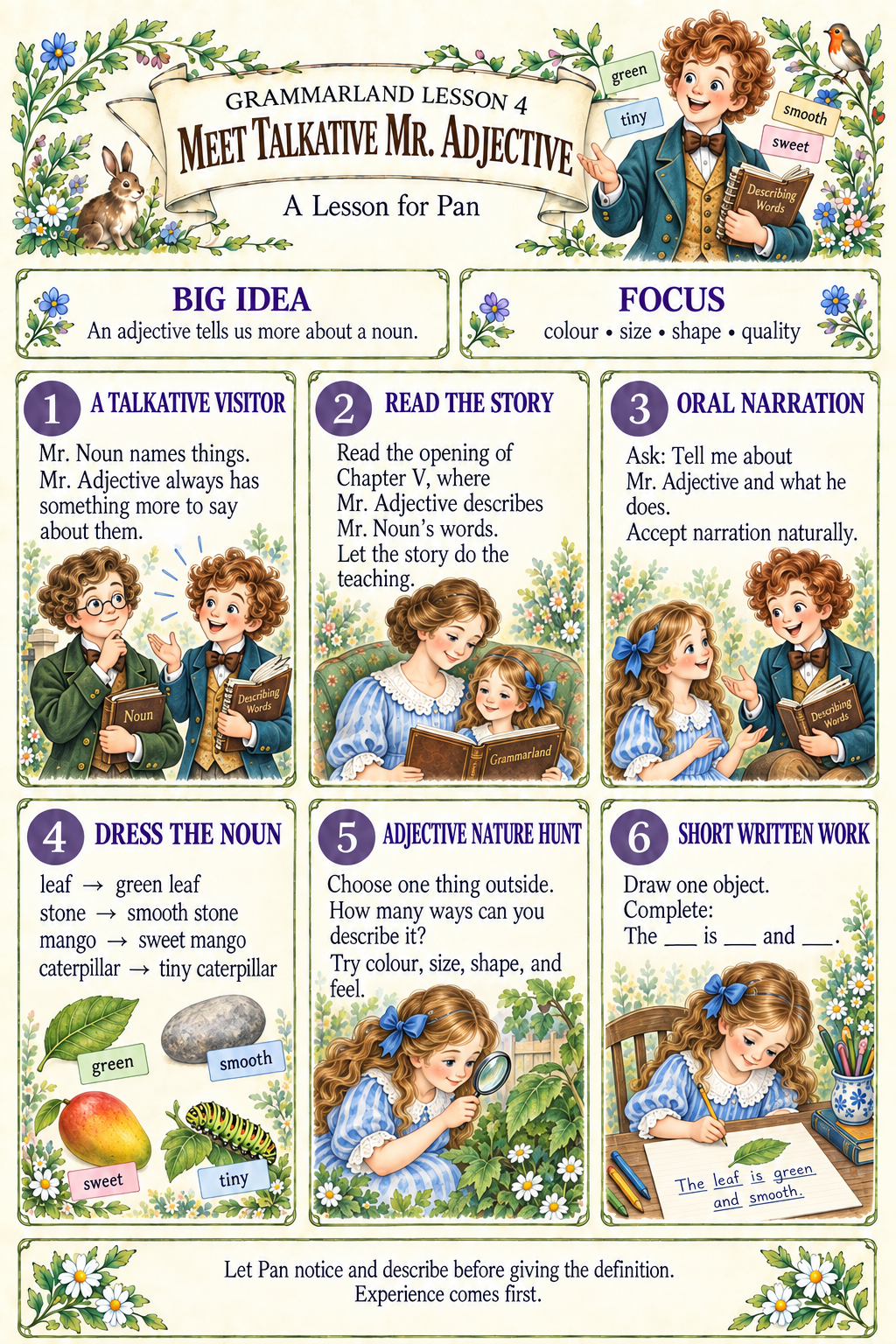
Rich Mr. Noun can give us the name of almost anything: an apple, a leaf, a ribbon, a stone, or a turtle. But the moment one of his words appears, another Grammarland citizen is ready to tell us more.
Is the apple red or green? Is the leaf broad or narrow? Is the ribbon long? Is the stone smooth? Is the turtle small?
That talkative visitor is Mr. Adjective. He brings colour, size, shape, number, and character to Mr. Noun’s words. With his help, a noun becomes easier to see in the mind.
We met him through Chapter V of Grammar-Land, then let his describing words spill naturally into our basket, our garden, and Pan’s notebook. (New here? Begin with our how to teach Grammarland guide, visit the Introduction courtroom play, and meet Rich Mr. Noun, Little Article, and Mr. Pronoun.)
Our Objective
By the end of this lesson, I wanted Pan to understand one simple idea:
An adjective is a word that tells us more about a noun.
I did not begin by asking her to memorise a definition or sort adjectives into several formal categories. At five, it was enough for her to notice that these words help us see which noun, what kind, or how many.
The definition came after the experience. First, she heard the words changing the picture in her mind.
What You’ll Need
- A Talkative Mr. Adjective character card or cutout
- A Rich Mr. Noun character card
- The Grammarland map
- A small basket with familiar objects
- Noun cards and adjective cards
- A notebook and pencil or coloured pencils
- The Mr. Adjective lesson guide on this page
Our basket held an apple, a leaf, a stone, a ribbon, and a small toy turtle. Use whatever is already nearby. The objects only need to be familiar enough for your child to observe and describe.
Our 20–25 Minute Lesson
1. Begin with a basket of nouns
I placed the objects in a basket and invited Pan to take them out one at a time. First, she simply named each one:
Apple. Leaf. Stone. Ribbon. Turtle.
These were all Mr. Noun’s words. Then I held up the apple and asked, “Can you tell me something more about it?”
Pan could say red, round, shiny, or sweet. Every new word added something to the plain noun. The apple had not changed, but the picture we made with words had become clearer.
2. A talkative visitor arrives
Then Talkative Mr. Adjective joined Rich Mr. Noun at the table. I introduced him in my best Grammarland voice:
Mr. Noun gives everything a name, but I always have something more to say about his words!
We let him describe each object:
- a green leaf
- a rough stone
- a long ribbon
- a small turtle
Mr. Noun still owned the name. Mr. Adjective simply stood beside it and told us more.
3. Read the story
We read the opening of Chapter V, where Talkative Mr. Adjective comes forward and describes Mr. Noun’s words. The story gives him such a clear personality: Mr. Noun names something, and Mr. Adjective can hardly resist adding another detail.
I read the story as it was written without stopping after every example. There would be time to examine the words afterwards. For now, I wanted Pan to meet the character and enjoy what he had to say.
4. Oral narration
When the book was closed, I asked:
Tell me about Mr. Adjective and what he does.
If a little invitation is needed, you might ask:
- Why is he called talkative?
- Whose words does he describe?
- What can he tell us about an apple?
Accept the narration naturally. A short answer such as, “He tells us more about nouns,” already shows that the central idea has landed.
5. Dress the noun
I laid out noun cards for cat, flower, castle, apple, bird, and turtle. Beside them were adjective cards such as tiny, red, tall, cheerful, spotted, golden, sleepy, and three.
Pan chose words to “dress” each noun:
| Mr. Noun’s Word | Mr. Adjective Adds |
|---|---|
| cat | sleepy cat |
| flower | red flower |
| castle | tall castle |
| bird | spotted bird |
| turtle | tiny turtle |
| apples | three apples |
Some combinations became sensible and others became funny. Both were useful. A sleepy castle made us laugh, while a golden apple made us think of a story. The game showed that adjectives change what we imagine, even when the noun stays the same.
6. Which one?
Adjectives do more than tell what something is like. They can also help us identify exactly which thing we mean.
I placed two or three objects together and gave Pan directions:
Please give me the long pencil.
Can you find the red ribbon?
Place the small stone beside the turtle.
She could see why the describing word mattered. Without it, she might not know which pencil, ribbon, or stone I wanted.
7. An adjective nature hunt
We carried Mr. Adjective into the garden and chose one thing at a time to observe. We found green grass, a tiny ant, rough bark, a white cloud, a yellow flower, and a tall tree.
I did not ask Pan to label every adjective she could see. We simply played with words that made each object more particular. The lesson moved from a character in a story to the real world outside our door.
8. Short notebook work
To finish, Pan chose one object from the nature hunt and drew it. Beneath the drawing, she completed a short sentence:
The flower is small and yellow.
If writing the whole sentence feels like too much, the child can copy only the two describing words while the parent writes the rest. The written work should remain smaller than the living experience that came before it.
Ending the Lesson
Before we returned the characters to the Grammarland map, I placed Mr. Noun and Mr. Adjective side by side and said:
Mr. Noun gives us the name. Mr. Adjective tells us more.
Our memory sentence was:
An adjective is a word that tells us more about a noun.
That was enough for one visit. Mr. Adjective had already filled the room, the basket, and the garden with words.
A Gentle Reminder
Let the child notice and describe before giving the definition. Experience comes first. Once the child has felt how a describing word changes a noun, the grammatical name has something real to attach itself to.
the free printable pack
Talkative Mr. Adjective and Rich Mr. Noun are included in our free Grammarland printable pack, together with the full-colour map, all nine character cards, courtroom characters, and a black-and-white map for colouring.
Get the free Grammarland packKeeping Mr. Adjective in the Conversation
During the week, choose one ordinary noun and invite Mr. Adjective to visit it. A turtle can become a small turtle, a slow turtle, a brown turtle, or a sleepy turtle. A leaf might be green, broad, smooth, curled, or dry.
You can also leave out the adjective and let the child repair the sentence:
Please bring me the ribbon.
If there are several ribbons, the child may naturally ask, “Which one?” That is the perfect moment for Mr. Adjective to do his work.
Why We Teach Adjectives This Way
A worksheet can ask a child to underline adjectives, but a basket, a story, and a walk show why those words matter. Adjectives sharpen attention. They ask a child to look again: not merely at a flower, but at its colour; not merely at a stone, but at its texture and shape.
That makes the lesson feel at home in a Charlotte Mason education. The child meets a lively character in a living book, narrates what was understood, handles real things, notices the natural world, and writes only after the idea has become her own.
Talkative Mr. Adjective may have many words, but our lesson did not need many exercises. One good story, a few familiar objects, and a child invited to look closely were enough.