Meeting Little Article: Teaching A, An, and The in Grammarland
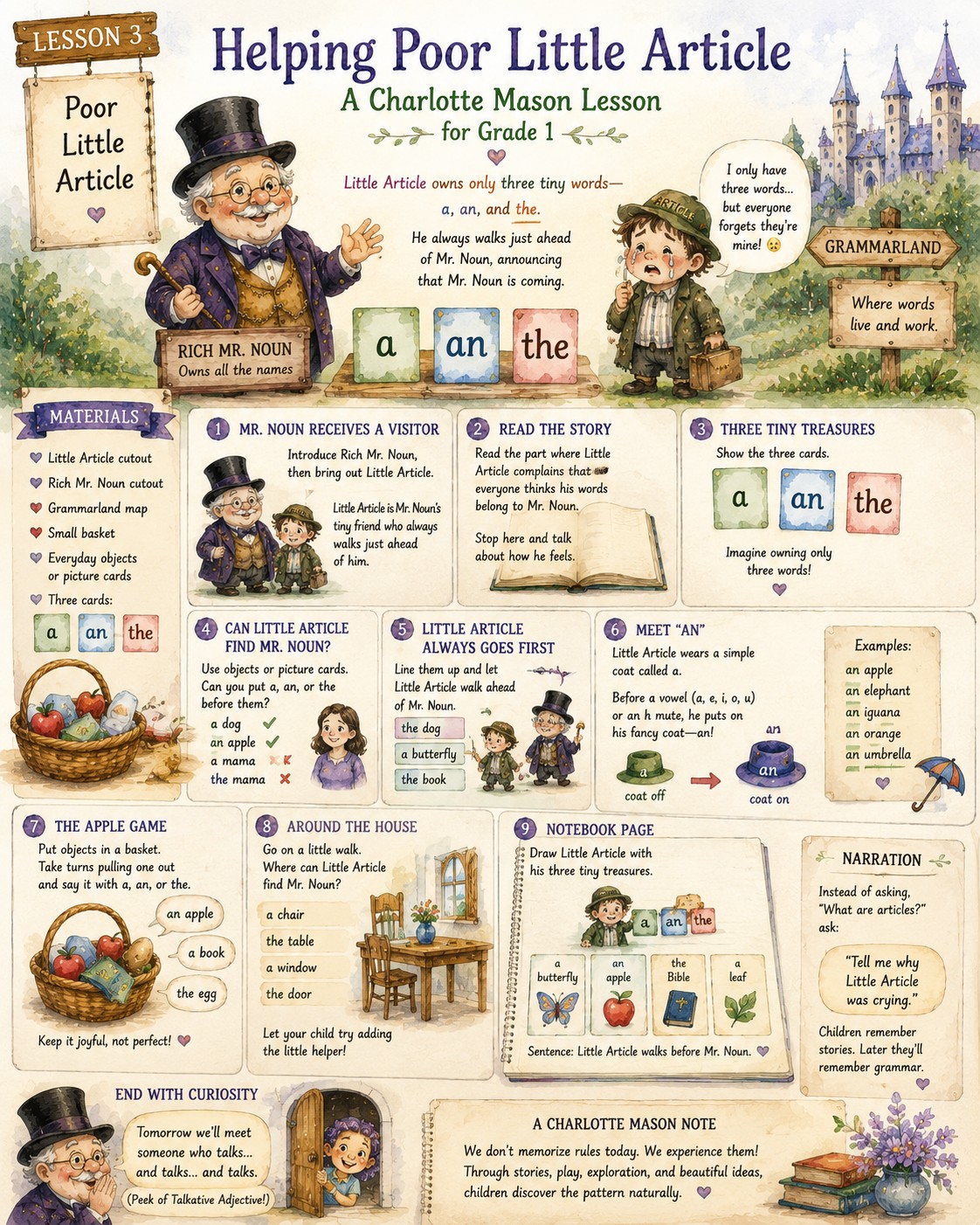
After a whole happy week with rich, contented Mr. Noun, Chapter II of Grammarland introduces his exact opposite: a ragged, tearful little fellow who owns only three small words in the entire kingdom — a, an, and the. He is Little Article, he lends his words to Mr. Noun whenever asked, and he is absolutely convinced everyone is taking advantage of him.
It's one of the most endearing chapters in the book — and, it turns out, a wonderfully gentle way to teach articles and that slippery little a-versus-an rule. Here's how we met him at our table, keeping the approach exactly as before: story first, plenty of play, and the definition saved for the very end. (New here? Start with how to teach Grammarland, then meet Rich Mr. Noun.)
Our Objective
By the end, Pan understood that a, an, and the are little "pointing" words that run ahead of nouns to announce them — and that an puts on its coat before a word that begins with a vowel sound. Not from a rule copied off a whiteboard, but from a poor little fellow she ended up feeling rather sorry for.
What You'll Need
- A Little Article cutout (free in our Grammarland printable pack)
- Three word cards: a, an, and the — Article's entire fortune
- Rich Mr. Noun and last week's basket of noun cards
- A tiny purse or coin pouch to hold Article's three little words
- A small paper coat for the "an is a with his coat on" trick (optional, but delightful)
- A nature journal and coloured pencils
The Step-by-Step Lesson
1. The poorest fellow in Grammarland
I set out Mr. Noun's overflowing basket from last week beside a tiny purse holding just three little cards. "This," I said, tipping out a, an, and the, "is everything Little Article owns in all the world." Pan looked at the fat basket, then the three lonely words, and was on his side before we'd read a single sentence. (Sympathy first; grammar second.)
2. Read the story
Then we opened the book and read Chapter II straight through — Little Article sobbing in court that his words are being counted as Mr. Noun's, Judge Grammar ordering that he be given his own separate mark, and stern, thin Dr. Syntax rising to deliver his one crucial rule. Read it right through, in your best courtroom voices, and trust the book to do its work.
3. Narration
After reading, one question: "Tell me about Little Article." If your child needs a nudge:
- Why was he crying?
- What does he own?
- What is his job in Grammarland?
- What did Dr. Syntax say?
4. Little Article runs ahead
Here's his whole purpose, and it's a gift for noun-spotting. As Serjeant Parsing says, he can always find Mr. Noun by catching sight of little Article running on ahead of him. So we laid out last week's noun cards, and Pan sent Article scampering in front of each one, dropping down an a or a the: "a dog," "the sky," "a spoon," "the mango tree."
Then the detective trick straight from the chapter: if you can put a, an, or the in front of a word, that word is a noun. We tested tricky ones on purpose — "a happy"? "the run"? They flop, and giggling, she declared them "not nouns." A whole grammar test, disguised as a game.
5. An puts on his coat
Now the rule everyone trips over, told the book's charming way: "a is only an with his coat off." Before a word that begins with a vowel sound — a, e, i, o, u — or a silent h, he must button his coat on and become an. We sorted words into two little piles:
| Coat off — "a" | Coat on — "an" |
|---|---|
| a book | an apple |
| a bird | an egg |
| a fly | an idol |
| a dog | an ox |
| a house | an umbrella |
| a hand | an hour (the h is silent!) |
Slip the little paper coat onto the a card and it becomes an — Pan loved dressing and undressing him. And do deliver Dr. Syntax's line in your most solemn, bony voice: "An is only used before a vowel or an h mute." Then sit down again, exactly as he does.
6. Out into the world
We took it outside and around the house, naming things and giving each its right little word by ear: "a leaf, an ant, the sky, an egg, the mango tree, an umbrella." Let the ear decide between a and an — children almost always feel it before they can explain it.
7. Nature notebook
Back inside, we opened the journal to a page titled Little Article's Three Words, drew his little purse holding a, an, and the, then made two columns — things that take a, things that take an — with a drawing or two in each. The drawing is the narration.
8. The memory sentence (last, of course)
Only now did we say it together:
An article is a little word — a, an, or the — that points to a noun. And an wears its coat before a vowel sound.
Experience first, definition second. By the time the rule arrived, Pan had already met the fellow it describes.
the free printable pack
Little Article's cutout is in our free Grammarland pack — with the full-colour map, all nine character cards, and a black-and-white map for colouring. Everything you need for the lesson, free.
Get the free Grammarland packEnding the Lesson
We did as Judge Grammar asked and gave Little Article his own separate mark — no more lumping his words in with Mr. Noun's. Then I lowered my voice for tomorrow's hook: "Little Article may be the poorest fellow in Grammarland. But tomorrow, someone far more colourful takes the stand — someone who simply cannot resist adding a little something to every noun she meets." Pan, of course: "Who?" "Talkative Adjective."
Keep the Story Alive
All week, keep him running about. During read-alouds, pause and ask, "Can you find me one little word that Little Article owns?" Just one. And when your child says "a apple," you needn't correct with a rule — just smile and whisper, "Coat on," and let them fix it to "an apple" themselves.
Serjeant Parsing ends the chapter by handing the children of Schoolroom-shire a little verse to hunt through for nouns and articles. We did the same — a lovely, low-pressure close:
Once there was a little boy,
With curly hair and pleasant eye;
A boy who always spoke the truth,
And never, never told a lie.
Can your child find every noun — and every little article running on ahead of one?
Why We Teach Grammar This Way
Charlotte Mason believed grammar should help children love language, not fear it. A lesson on articles could so easily be three rules and a worksheet. Instead, Grammarland gives us a poor, proud little fellow who cries in court, lends out his three words, and dresses a in a coat to make an — and suddenly the rules are things your child already knows, because they watched them happen. Take your time, feel a little sorry for Little Article, and let the definition arrive last. Next up, whenever you're ready: Talkative Adjective.