How to Teach Grammarland: Story-First Strategies That Actually Stick
If you're wondering how to teach Grammarland, here's the whole secret in one sentence: introduce the characters before you crack open the text, and let the story carry the grammar so the rules feel like plot twists instead of punishments. The book by M.L. Nesbitt turns the parts of speech into courtroom personalities, and once your child knows who's who, the lessons basically run themselves — which, if you homeschool, is the closest thing to a day off you're going to get.
Key Takeaways
- Introduce the characters before reading Lesson 1 aloud — especially if your child breaks out in hives at the phrase "once upon a time."
- Printed cutouts make narration possible even when the vocabulary is doing its best 19th-century impression.
- Grammarland teaches nine parts of speech through allegory, so your method should lean into the imagination, not fight it.
- Assessment doesn't need a worksheet: narration, character play, and sentence sorting all count.
- Pace it to your child. One or two pages per session is plenty — this is not a race, and nobody's timing you.
- It shines as a read-aloud paired with hands-on activities, not as silent solo reading.
What Grammar-Land by M.L. Nesbitt Actually Is
Grammar-Land (also spelled Grammarland) is a 19th-century children's book by M.L. Nesbitt that teaches the nine parts of speech through one long, delightfully dramatic allegory. Judge Grammar presides over Schoolroom-Shire, each part of speech shows up as a character with its own personality, Serjeant Parsing investigates grammar crimes, and Dr. Syntax enforces the rules like the strictest substitute teacher you've ever met.
Think less "textbook" and more "courtroom drama." Noun is the reliable citizen who shows up to jury duty. Verb is the one always caught doing something. And Interjection is that guy who bursts through the door yelling before anyone asked him a thing. The nine parts of speech on trial are Noun, Pronoun, Article, Adjective, Verb, Adverb, Preposition, Conjunction, and Interjection.
The book is a staple in classical and Charlotte Mason homeschool circles because it fits the idea that children learn best from living books rather than dry drills. If you want the wider philosophy, the Charlotte Mason Help website offers curriculum context that's genuinely useful for Filipino homeschool parents juggling DepEd-aligned or alternative programs.
Lesson 1: Judge Grammar and His Subjects, Explained Properly
Read the Characters Before You Read the Book
Here's the honest truth about Lesson 1: if you just open the book and start reading, your child may quietly leave the building by paragraph three. Ask me how I know. When we first started, Pan hit a wall on nearly every word — the vocabulary was genuinely unfamiliar. And the book's cheerful comparison to Fairy-land? Zero help. Pan has never been a fairy-tale kid. She's a science reader — the kind who'll happily narrate the life cycle of a beetle but looks at an enchanted forest like it owes her data.
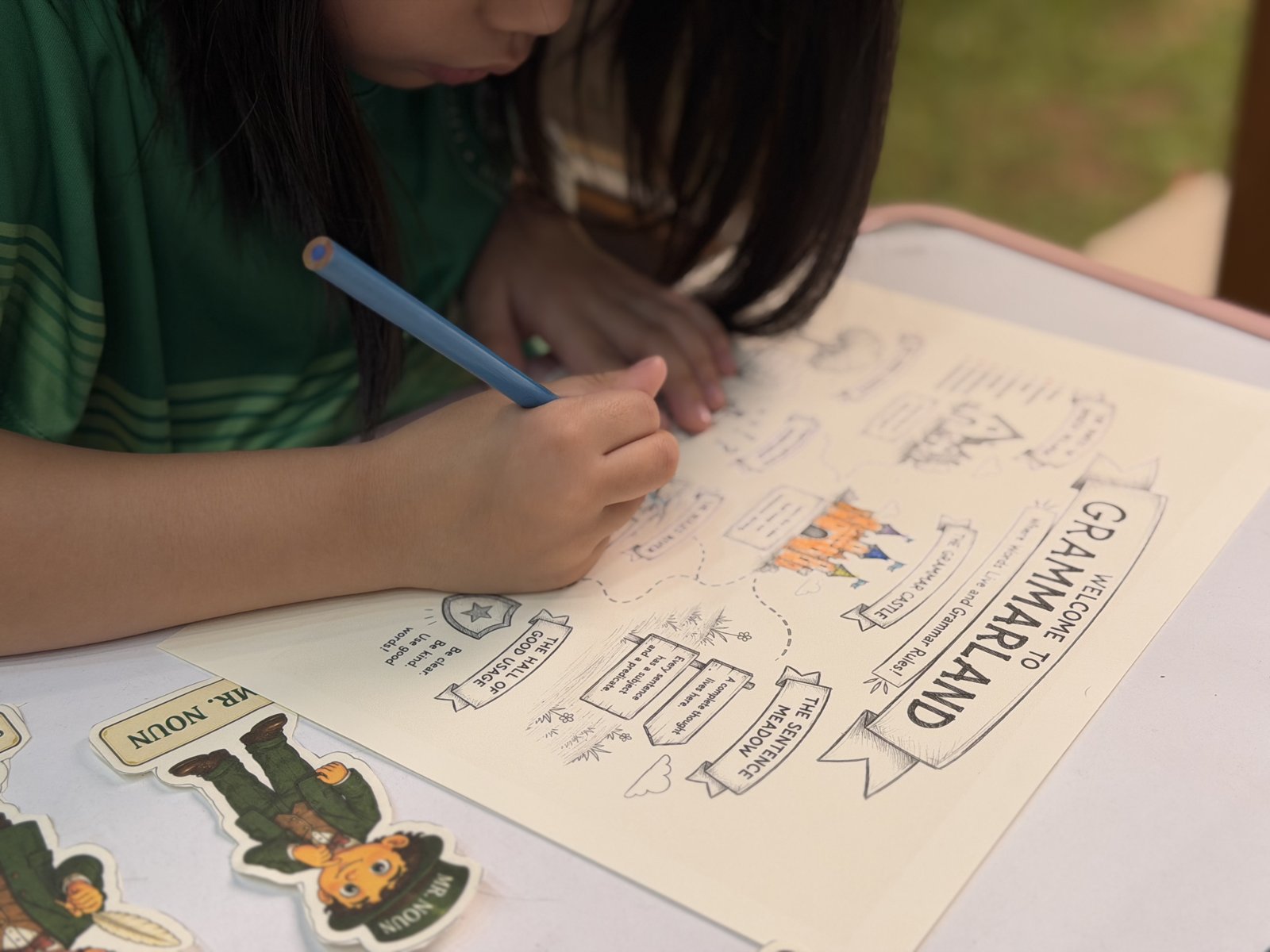
So I closed the book, set the lesson aside, and came back to it that evening as parent homework. I read Grammarland alone, took notes, and used ChatGPT to generate character images of Judge Grammar and the rest of the Schoolroom-Shire cast. I also printed a coloring sheet of what the Grammarland landscape might look like, ready for the morning. Roughly one evening of prep — the cheapest lesson upgrade I've ever bought.
The Cutout Method That Changes Everything
The next morning, instead of opening the book again, we cut out the characters, colored the pictures, and just… talked about them. No formal lesson. No reading. Just a conversation about who Judge Grammar is, what Serjeant Parsing does, and why Dr. Syntax is clearly the most serious person in any room he enters.
The following lesson, we went back to pages one and two — and narration happened all on its own, because Pan already knew everyone being mentioned. She used the cutouts to retell the scene, sliding them around the table like actors hitting their marks. That was the moment Grammarland clicked. No convincing required.
This is exactly what the Charlotte Mason narration method is built to do: give kids a way to process and own what they've read. But narration only works when the material is reachable in the first place. Character prep is how you build the ladder.
What the Characters Actually Represent
Here's the quick who's-who of the nine parts of speech, Grammarland-style:
| Character | Part of Speech | Core Function |
|---|---|---|
| Judge Grammar | Grammar itself | Ruler of Schoolroom-Shire and keeper of all the rules |
| Noun | Noun | Names people, places, and things |
| Pronoun | Pronoun | Stands in for Noun (the understudy) |
| Article | Article | Points to or introduces a noun |
| Adjective | Adjective | Describes Noun |
| Verb | Verb | The action-taker, always up to something |
| Adverb | Adverb | Modifies Verb, Adjective, or another Adverb |
| Preposition | Preposition | Shows relationships between words |
| Conjunction | Conjunction | Joins words and clauses |
| Interjection | Interjection | Bursts in with sudden emotion. Oh! Uninvited, as usual. |
Skip the sketching — grab the free printable pack
Don't fancy drawing Judge Grammar yourself? We made a free 4-page Grammarland printable pack: the full-colour map, all nine character cards, cut-out figures of the courtroom cast, and a black-and-white map for colouring. Pop in your email and it's yours.
How to Structure Grammarland Lessons by Age and Learning Level
One of the biggest gaps in most Grammarland resources is that nobody tells you how long a lesson should take or how to adapt it for different learners. So here's a framework that actually accounts for the human sitting across the table from you:
For early learners (ages 6 to 8)
- Spend two to three sessions just meeting the characters before any reading begins.
- Read one to two pages per session. Maximum. Resist the urge to "just finish the chapter."
- Use cutouts for all narration.
For middle learners (ages 9 to 11)
- One session of character preview is usually enough.
- Read three to four pages per session.
- Add a sentence-sorting activity: which character (part of speech) does each word belong to?
For older learners (ages 12 and up)
- Read the chapter in full, then discuss.
- Assign written narration or a short summary in their own words.
- Introduce basic sentence diagramming as a companion activity.
Many Filipino homeschool families run a rhythm-based daily schedule aligned with DepEd's K-12 framework, and Grammarland fits that beautifully — no sprinting required. Even one solid lesson per week builds real grammar understanding. You can cross-check the DepEd official curriculum guides for Grade 3 to 5 English to see how Grammarland's content maps onto formal learning objectives.
Assessment Without a Worksheet
You don't need a test to know your child learned something. (You'll usually know because they won't stop talking about Verb.) Here are assessment methods that actually work:
- Oral narration with cutouts: Can your child explain what Judge Grammar does using the character card?
- Sentence labeling: Write a simple sentence and have them point to which character each word is.
- Creative retelling: Ask them to draw a scene from Schoolroom-Shire and describe what's happening.
- Grammar card game: A quick matching game — character names to part-of-speech definitions.
These approaches line up with what Philippine researchers on mother-tongue-based instruction have noted: kids show understanding far better through production tasks than through multiple-choice recall.
Things to Know Before You Dive In
- Grammarland was written in the 19th century, so some vocabulary will feel like it wandered in from another era — preview the text yourself first.
- The book is in the public domain, so a free, fully legal PDF is yours for the taking from Project Gutenberg.
- The Fairy-land comparison only lands if your child has fairy-tale context. If they don't, swap in something they actually know.
- Narration will flop if the child doesn't know the characters yet. Always do character prep before the first read.
- Cutouts made from printed character images are cheap, reusable, and survive being flung across the table more than once.
Frequently Asked Questions
What age is Grammarland appropriate for?
Grammarland typically suits children ages 8 to 12, though younger kids can enjoy it with strong parental support. The vocabulary and allegory need a little reading maturity, but the story format makes it accessible earlier than most formal grammar texts. With the cutout method above, even a 7-year-old can engage meaningfully.
Is Grammarland a complete grammar curriculum?
No — Grammarland introduces the parts of speech conceptually, but it doesn't cover sentence construction, punctuation, or advanced rules in depth. It works best as a literary introduction to grammar, paired with a more structured program for practice. Many Charlotte Mason homeschoolers run it alongside copywork and dictation.
Where can I get Grammarland for free?
Grammarland is in the public domain and available as a free download on Project Gutenberg. You can grab the full text as a PDF or ebook at no cost, and printing selected pages for lessons is completely legal and endlessly practical for homeschool families.
What do I do if my child refuses to engage with Grammarland?
Stop the reading session, do the character prep yourself, and come back with visual aids before trying again. This is exactly what worked for us. Forcing through unfamiliar text rarely produces learning — it mostly produces sighing. One evening of parent prep can make the next day's lesson a completely different experience.
Does Grammarland align with DepEd's English curriculum standards?
Grammarland covers parts of speech, which are explicitly included in DepEd's Grade 3 to 5 English competencies. Filipino homeschool families registered under DepEd can use it as a supplementary English language arts resource. Always cross-reference with your registered curriculum provider's requirements to stay compliant.
The Bottom Line on How to Teach Grammarland
Knowing how to teach Grammarland comes down to a single principle: the story only works once the child knows the characters. Skip the prep and you'll spend the whole lesson translating vocabulary instead of teaching grammar. Do the prep — make the cutouts, color the pictures, then read the book — and you'll end up with a child narrating courtroom scenes back to you with the kind of enthusiasm you usually have to bribe out of them.
Your action step this week: read Lesson 1 yourself tonight, sketch or generate simple character images for Judge Grammar and the nine parts of speech, and spend your next homeschool session entirely on introductions — not a single page of the book opened yet. The lesson after that? That's the one where it finally clicks.
walk with us
Once-a-week notes, book finds, and free printables for fellow Filipino homeschoolers.
Join the Community