Turn the Grammarland Introduction into a Courtroom Play
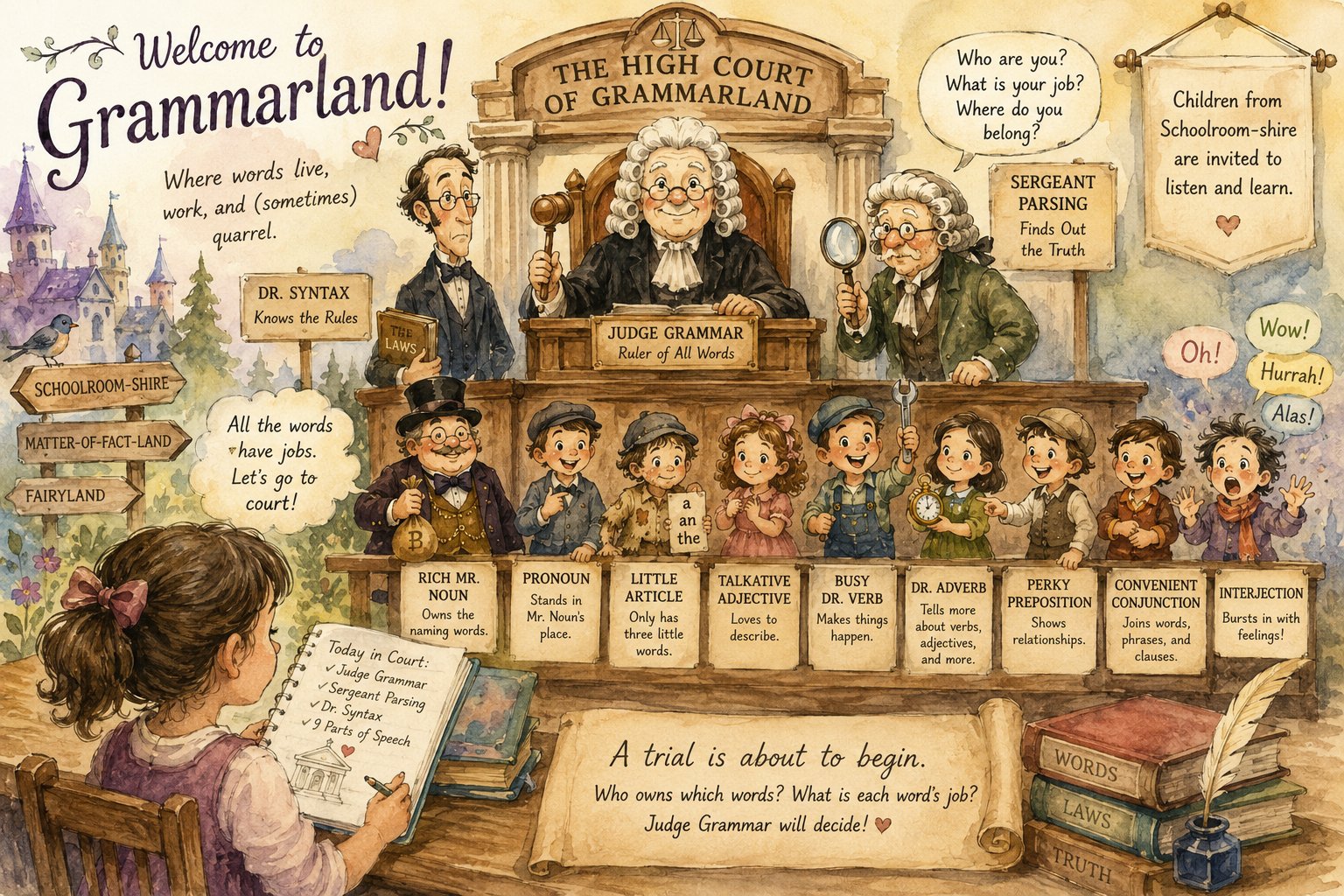
If you've opened Grammarland to Lesson 1 and felt your Grade 1 child slide quietly off the chair by the third sentence, you are not doing it wrong. The introduction is long, and it's written in the kind of old-fashioned English that assumes everyone in the room already loves a courtroom. Read as a "read-and-discuss" lesson, it asks a six-year-old to sit still through vocabulary they don't have yet and then answer questions about it. That's a tall order.
So we stopped reading it. We performed it instead. And that's when the whole thing came alive for Pan — because the introduction of Grammarland isn't really a chapter to get through. It's a scene. It practically begs to be acted out.
The only goal for this first lesson
You are not teaching the nine parts of speech today. Resist the urge. All your child needs to walk away understanding is the shape of the story:
- Grammarland is the kingdom of words.
- Judge Grammar keeps order there.
- The parts of speech have started quarrelling.
- Sergeant Parsing investigates who each word is.
- Dr. Syntax decides whether words are used properly.
- And your child has been personally invited to attend the trial.
That's it. Everyone stays a happy mystery for now. Acting the scene out lets your child follow the story without needing to understand every antique sentence on the first pass — which is exactly what makes the real reading possible later.
The Grammarland Courtroom
Plan for about twenty to twenty-five minutes. It moves quickly once you begin, and honestly, the setup is half the fun.
Set the scene before you start
Before the lesson, arrange your little courtroom. Nothing fancy — the kitchen table is a perfectly dignified High Court.
- Judge Grammar at the center.
- Dr. Syntax on one side, Sergeant Parsing on the other.
- The nine parts of speech hidden in a basket or tucked behind the book, ready to be summoned.
- A small gavel — a wooden block, a spoon, whatever bangs with authority.
- A chair for your child, labeled Schoolroom-shire.
- The Grammarland map nearby.
If you're feeling ambitious, prop up a little sign that reads The High Court of Grammarland. Pan took this part very seriously and insisted on decorating hers.
Begin outside the story
Do not open the book yet. Instead, hand your child a folded piece of paper and say, with appropriate gravity, "A letter has arrived for you." Then read the invitation aloud:
To the children of Schoolroom-shire,
You are invited to attend the High Court of Grammarland. The parts of speech have been quarrelling, and Judge Grammar must settle the matter. Bring your pencil, your notebook, and your listening ears.
Signed, Sergeant Parsing
Then ask the only question that matters: "Shall we go?" Let your child carry the invitation over to the Grammarland map. You are now, officially, on your way.
Enter Grammarland
Point to the map and say, "Grammarland is not found on any ordinary globe. It is the land where words live and work." Give your child a moment to just look at it — the palace, the bridge, the little houses.
Then place Judge Grammar in the courthouse. "Judge Grammar rules over every word spoken in Grammarland. Even kings and queens must follow his laws, so that people can understand one another." Offer one small example: "We say 'I am happy,' not 'I is happy.'" Then tap the gavel. "Order in Grammarland!" (Children love banging the gavel. Budget for this.)
Introduce the problem
Now make the hidden parts of speech rustle and bicker. Different voices, please — commit to the bit:
"That word belongs to me!"
"No, it does not!"
"I found it first!"
"You already have far too many words!"
Judge Grammar wakes from his nap with a start: "What is all this noise?" And with that, the trial has a reason to exist. Bring out Sergeant Parsing and Dr. Syntax to help him sort it out.
Meet Sergeant Parsing
Say: "Sergeant Parsing is the court investigator. He finds out who each word is, and what work it is doing." Hand him a magnifying glass if you have one lying around — it makes him ten times more convincing.
Try a simple sentence: The bird sings. Let Sergeant Parsing do the questioning:
"Who is in the sentence?" — "The bird."
"What is the bird doing?" — "Singing."
Don't rush to say noun and verb unless your child gets there on their own. The point right now is only this: Sergeant Parsing asks questions, and questions uncover each word's job.
Meet Dr. Syntax
Say: "Dr. Syntax knows the laws of Grammarland. He checks whether the words are arranged properly." Then put two sentences on trial:
The bird sings.
The bird sing.
Ask, "Which one sounds right?" Let Dr. Syntax deliver the verdict solemnly: "The bird sings." You can let your child hold up a card that says RIGHT, like a tiny, very serious judge. It makes Dr. Syntax's job concrete without a single word of formal grammar.
Summon the parts of speech
Now Judge Grammar calls the whole cast forward: "Let all nine parts of speech come before the court!" Bring each one out briefly, with a single line — a quick handshake, not an interrogation:
- Rich Mr. Noun owns names.
- Pronoun stands in Mr. Noun's place.
- Little Article owns only three small words.
- Adjective loves to describe.
- Dr. Verb keeps everyone busy.
- Adverb tells more about the action.
- Preposition shows where things are.
- Conjunction joins things together.
- Interjection bursts in with sudden feelings.
Line them up before Judge Grammar — then let them go. Do not ask your child to remember all nine. Just promise, like a good serialized story, "We will meet them one at a time as the trial continues."
Now read the book
Only now do you open Grammarland — and only the most vivid parts of the introduction:
- the description of Grammarland,
- Judge Grammar waking from his nap,
- the arrival of Sergeant Parsing,
- the arrival of Dr. Syntax,
- the invitation to Schoolroom-shire,
- the court assembling.
You don't have to read every paragraph in one sitting, and you certainly don't have to read them in order of appearance. Because your child has already seen the scene, the old-fashioned language suddenly has somewhere to land. The words describe something they already know.
Let your child join the court
Hand over a notebook or a small slate. Say, "Judge Grammar invited children from Schoolroom-shire because he wants them to learn how words should be used." Then make it official: "You are now a visitor to the Court of Grammarland." A tiny paper badge that reads Visitor from Schoolroom-shire is entirely optional and completely irresistible.
Narration — but make it play
Instead of the dreaded "What happened in the story?", try: "Show me what happened when Judge Grammar woke up." Let your child move the cutouts and retell the scene with their hands. A few more prompts that feel like play, not recitation:
- "Who would Judge Grammar call if he wanted to know what job a word was doing?"
- "Who decides whether the words are arranged correctly?"
- "Why were the children invited?"
It's still narration — the heart of a Charlotte Mason lesson — but it arrives dressed as a game.
End on a cliffhanger
Judge Grammar taps the gavel one last time: "The court will hear the first case tomorrow." Then hold up Rich Mr. Noun and announce, "Rich Mr. Noun, you will be the first to explain which words belong to you." Set him by the courtroom door, waiting. You have just turned tomorrow's lesson into something your child is actually looking forward to. That is a small miracle you should absolutely take credit for.
A simple notebook page
Skip the full written lesson. Make a courtroom record instead. Title it The Court of Grammarland, then draw or paste three characters:
- Judge Grammar — keeps order.
- Sergeant Parsing — finds out each word's job.
- Dr. Syntax — checks the laws.
And one line at the bottom: The parts of speech have been called to court. Your child might copy only the title, or a single sentence. For a Grade 1 hand, that's plenty.
grab the free printable pack
You'll need Judge Grammar, Sergeant Parsing, Dr. Syntax, the nine characters, and the Grammarland map for this play — and we've made them all free. The pack includes the full-colour map, the character cards, cut-out figures, and a black-and-white map for colouring.
Get the free Grammarland packWhy this works
Your child meets the chapter first as a story and a scene, not as a wall of text. The names — Judge Grammar, Sergeant Parsing, Dr. Syntax — become meaningful because your child has watched what they do. The nine parts of speech stay mysterious characters waiting for their turn in court, rather than a list to be memorized before breakfast.
And most importantly, it creates anticipation. Grammarland stops being a textbook to finish and becomes a trial your child has been personally invited to attend. That's a very different feeling to carry into Lesson 2 — and it's the whole reason the story was written as a story in the first place.
If you're just meeting the Schoolroom-shire cast for the first time, you might start with how to teach Grammarland — the character-first approach that makes all of this click. Then come back, put on your robes, and call the court to order.