Meeting Mr. Pronoun: The Helpful Friend Who Takes Mr. Noun’s Place
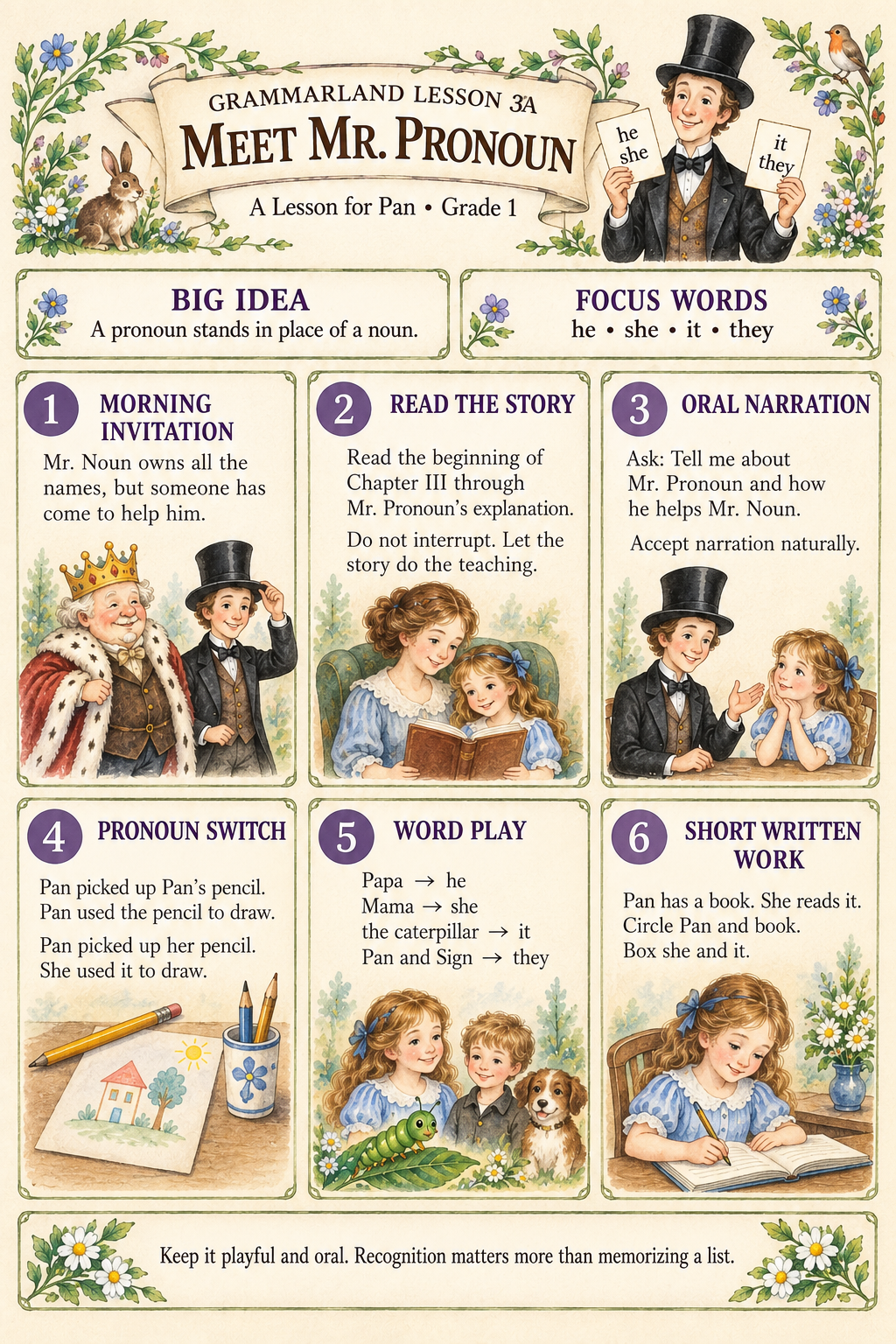
Rich Mr. Noun may own every name in Grammarland, but even a gentleman as wealthy as he is needs a little help.
Imagine having to say: “Pan picked up Pan’s pencil. Pan used the pencil to draw. Then Pan placed the pencil on the table.” It is understandable, but it sounds terribly tiring. Fortunately, Mr. Noun has a useful friend who is always ready to take his place.
His name is Mr. Pronoun.
In Grammar-Land, Mr. Pronoun explains that his words stand instead of nouns. He steps into a sentence and carries Mr. Noun’s work without making us repeat the same names again and again.
So instead of beginning with a list of pronouns to memorise, we met the gentleman who owns them. We spent two short lessons with Mr. Pronoun: first discovering how he replaces repeated names, and then learning how his words change depending on who is speaking and whom we are speaking about. (New here? Start with our how to teach Grammarland guide, visit the Introduction courtroom play, then meet Rich Mr. Noun and Little Article.)
Our Objective
By the end of these two lessons, I wanted Pan to understand one living idea:
A pronoun is a word that stands in place of a noun.
I did not expect her to recite every pronoun or explain the difference between subject and object pronouns. At five, it was enough for her to hear a repeated name, recognise how awkward it sounded, and discover which little word could take its place.
The goal was not a memorised list. It was for her to understand why Mr. Pronoun is needed.
What You’ll Need
- A Mr. Pronoun character card or cutout
- A Rich Mr. Noun cutout
- The Grammarland map
- Small toys, objects, or picture cards
- Slips of paper with pronouns written on them
- A small basket or pouch
- A notebook and pencil
- The two Mr. Pronoun lesson guides on this page
Because Chapter III introduces many kinds of pronouns, we divided it into two short lessons. This gave Pan time to meet the words through conversation and play without turning one lively chapter into a long grammar lecture.
Part One: Mr. Pronoun Takes Mr. Noun’s Place
1. A helpful visitor arrives
We began by bringing Rich Mr. Noun back to the table. I reminded Pan: “Mr. Noun owns all the names in Grammarland. But someone has come to help him.”
Then Mr. Pronoun appeared beside him. In my best Grammarland voice, he announced:
Mr. Noun has so many names to look after. When he does not want the same name used again and again, I stand in his place.
That was enough to make Pan curious. What kind of words could replace a person’s name? Could a word really stand in for a caterpillar, a pencil, or even Papa?
2. Read the story
We read the beginning of Chapter III, where Mr. Pronoun enters Judge Grammar’s court and explains his work.
Mr. Pronoun says that pro means “instead of,” so a pronoun is a word used instead of a noun. He describes himself as Rich Mr. Noun’s hardworking neighbour, always ready to keep Mr. Noun’s names from being worn out through constant repetition.
I read without interrupting to explain every pronoun. The story had already placed the important idea before Pan: Mr. Pronoun comes when Mr. Noun needs someone to stand in his place.
3. Narration
After reading, I asked:
Tell me about Mr. Pronoun and how he helps Mr. Noun.
If your child needs a little help getting started, you might ask:
- Why does Mr. Noun need a friend?
- What does Mr. Pronoun do?
- Why would we use she instead of saying someone’s name repeatedly?
Try not to turn the conversation into a test. Even a short answer such as, “He takes Mr. Noun’s place,” shows that the main idea has landed.
4. The repeating-name problem
Next, I gave Pan a sentence that sounded deliberately awkward:
Pan picked up Pan’s pencil. Pan used the pencil to draw. Then Pan placed the pencil on the table.
We said it aloud and laughed at how often her name appeared. Then Mr. Pronoun came to the rescue:
Pan picked up her pencil. She used it to draw. Then she placed it on the table.
We physically moved Rich Mr. Noun’s character aside and placed Mr. Pronoun in his spot each time a pronoun replaced a noun. The idea became visible: Mr. Noun had not disappeared forever. His friend was simply standing in for him.
5. The pronoun switch
I named a person, animal, or thing, and Pan chose a pronoun to take its place:
| Mr. Noun’s Word | Mr. Pronoun’s Helper |
|---|---|
| Papa | he |
| Mama | she |
| the caterpillar | it |
| Pan and Sign | they |
| the books | they |
| the flower | it |
We kept this part oral and playful. Sometimes I chose the wrong pronoun on purpose: “Mama is watering the plants. He is in the garden.” Pan corrected me at once: “No, Mama is she!”
There is something satisfying about being allowed to correct Mama, especially in Grammarland.
6. Short written work
After the story and word play, we finished with two sentences:
Pan has a book. She reads it.
I asked Pan to circle Pan and book, draw a box around she and it, and tell me whom or what each pronoun stood for. The written work remained short because most of the lesson had already happened through reading, narration, conversation, and play.
Part Two: Mr. Pronoun Has More Helpers
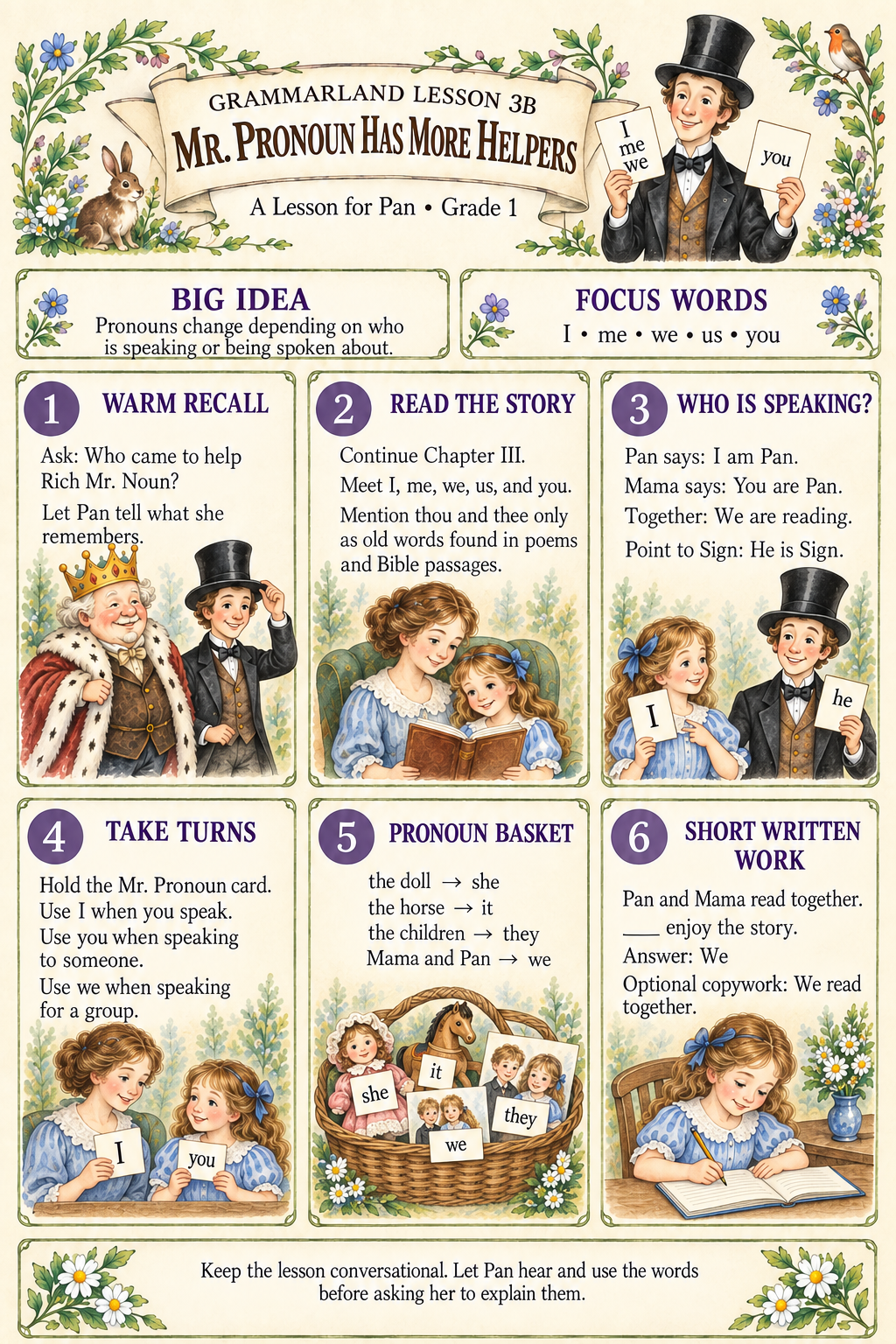
The next time we visited Grammarland, we began by remembering the friend we had already met.
1. Warm recall
Before reopening the book, I placed Rich Mr. Noun and Mr. Pronoun on the table and asked:
Who came to help Rich Mr. Noun?
Pan told me what she remembered. I let her narration stand before adding anything. This small recall connected the two lessons without requiring a formal review. Mr. Pronoun was already becoming someone familiar.
2. Continue the story
We continued Chapter III and met more of Mr. Pronoun’s words:
- I and me for the person speaking;
- we and us when the speaker includes other people;
- you for the person being spoken to;
- he, she, it, and they for the people or things being spoken about.
The book also introduces thou and thee. I simply explained that these are older words we may hear in poems, hymns, and Bible passages. They did not need to become the main work of our lesson.
3. Who is speaking?
Instead of beginning with grammatical categories, we used the pronouns in a real conversation.
Pan held a card marked I and said, “I am Pan.” I held you and answered, “You are Pan.” Standing together, we said, “We are reading.” Then we pointed to Sign: “He is Sign.”
We repeated the activity with toys and family members: “She is Mama. It is a horse. They are playing.”
The words changed depending on who was speaking and whom we were talking about. Pan did not need those exact terms yet. She was already hearing the relationship through the sentences.
4. Take turns being Mr. Pronoun
We took turns holding the Mr. Pronoun character card. The person holding it had to make a sentence using one of his words:
I have the card.
You have the basket.
We are learning.
He is playing.
She is reading.
When Sign wandered into the lesson, he became part of our demonstration: “He wants the basket.” And when both children began examining the objects: “They are looking inside.” Real life had kindly supplied the next example.
5. The pronoun basket
I placed a few toys and picture cards in a basket. Pan pulled out one item at a time and chose a pronoun to replace its name.
| What Pan Found | Pronoun |
|---|---|
| the doll | she |
| the toy horse | it |
| a picture of several children | they |
| a picture of Mama and Pan | we |
| a picture of Papa | he |
We began each turn with the noun: “The doll is sleeping.” Then we let Mr. Pronoun take over: “She is sleeping.”
This made the difference between a noun and a pronoun much easier to see. Mr. Noun gives us the name first. Mr. Pronoun can then stand in its place.
6. Short written work
For our final activity, I wrote:
Pan and Mama read together. ___ enjoy the story.
Pan supplied: We.
Her optional copywork line was: “We read together.” One short sentence was enough. The purpose was not to fill a page but to let her use one of Mr. Pronoun’s words with understanding.
Ending the Lesson
Before packing away the characters, we looked at Rich Mr. Noun and Mr. Pronoun standing side by side.
Mr. Noun owns all the names, but he no longer has to do all the work alone. His useful friend can stand in his place.
Then we returned both characters to the Grammarland map. But Judge Grammar’s court was not finished with them yet. Someone would soon visit Schoolroom-shire and ask us to recognise Mr. Noun, Little Article, and Mr. Pronoun working together inside a story.
That someone was Serjeant Parsing.
the free printable pack
Mr. Pronoun and Rich Mr. Noun are both included in our free Grammarland printable pack, along with the full-colour map, all nine character cards, the courtroom characters, and a black-and-white map for colouring.
Get the free Grammarland packKeeping Mr. Pronoun in the Conversation
The lesson does not need to end when the guide is put away. During the week, whenever a name is repeated too many times, we can invite Mr. Pronoun to help:
Pan found a butterfly. Pan watched the butterfly.
Then ask: “Can Mr. Pronoun make that sentence sound better?”
During read-aloud time, choose just one pronoun and ask whom or what it stands for. There is no need to search an entire page or identify every pronoun in sight. One meaningful example is often enough.
You might also make playful mistakes: “Papa is working. She is busy.” Children are remarkably alert when an adult gets something wrong.
Why We Divided the Chapter into Two Lessons
Chapter III contains far more than the first few pronouns children usually meet. Along with I, me, we, us, you, he, she, it, and they, the chapter introduces possessive words, older pronouns, and words such as who, which, this, and that.
There is no need for a young child to master all of these in one sitting. Dividing the chapter gave Pan time to understand the central relationship first: pronouns stand in place of nouns. The second lesson then allowed her to hear how those words change during a conversation.
We can return to the other pronouns later, when stories and sentences naturally call for them.
Why We Teach Pronouns This Way
A list may tell a child which words are pronouns, but a story shows why those words exist.
Mr. Pronoun is memorable because he has a purpose. He is not simply another term to define. He is Rich Mr. Noun’s useful friend — the gentleman who steps forward when a name has already done enough work.
That image gives children something to hold on to. When Pan encounters he, she, it, they, I, we, or you in future lessons, she can remember the character who came to help. The terminology grows from a relationship she already understands.
This is one of the loveliest things about learning grammar through Grammar-Land. Words are not separated from stories, people, humour, or imagination. Each part of speech is introduced as someone worth knowing.
And so we are not racing through the kingdom. We are meeting its citizens one by one, listening to their stories, and discovering the work each one has been doing inside our sentences all along. Next in Grammarland: Serjeant Parsing comes to visit.