How to Homeschool in the Philippines: Methods, Legalities, and What Nobody Warns You About
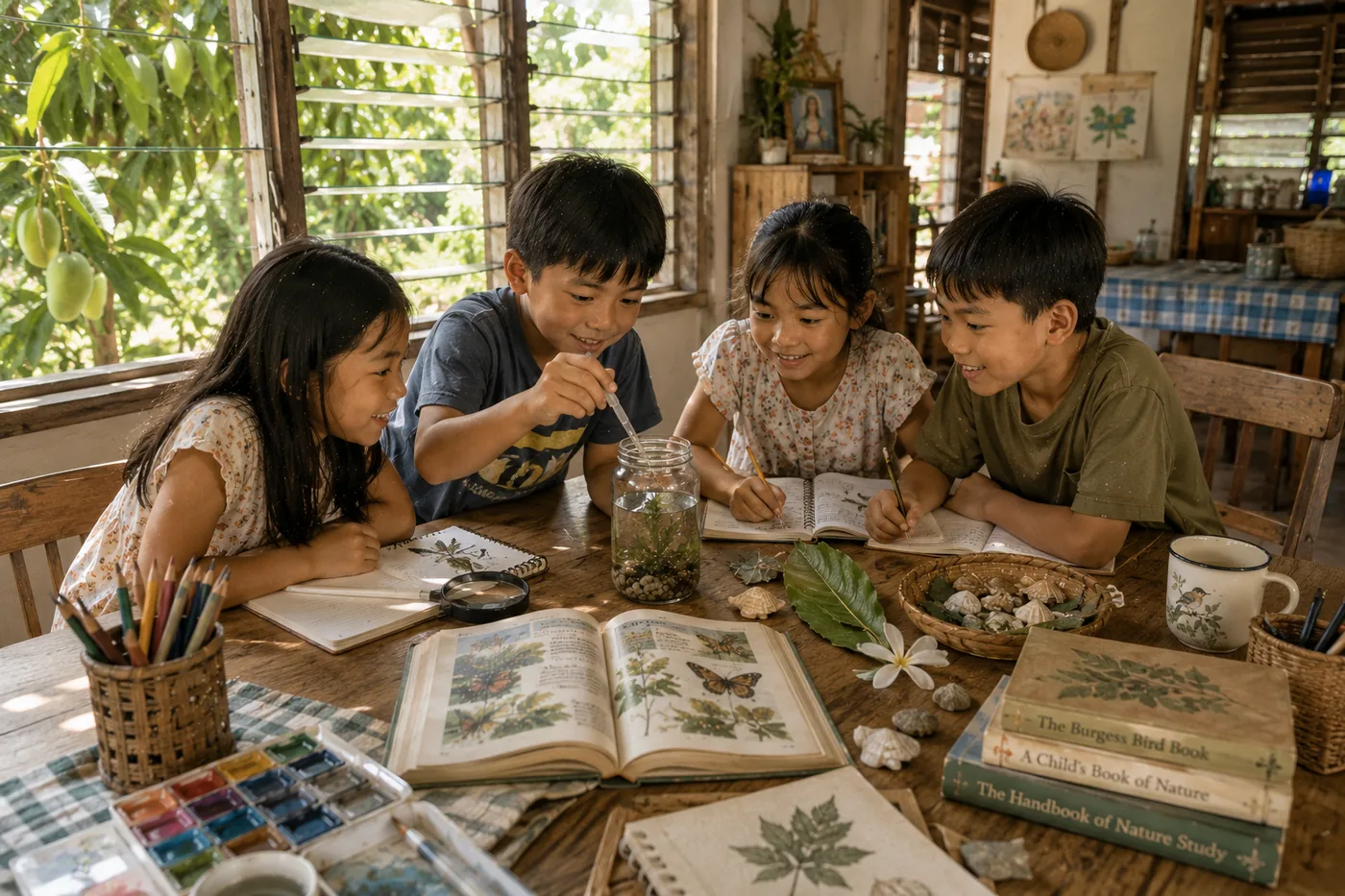
Homeschooling in the Philippines is completely legal, recognized by the Department of Education (DepEd), and more popular than ever, with thousands of Filipino children now learning from home. If you've been Googling how to homeschool in the Philippines for the past three weeks at midnight, congratulations — you've come to the right place.
I'll be honest with you. When I started preparing for our first official homeschool year this SY 2026–2027, I thought I'd find one clean checklist somewhere and just follow it. What I found instead was a beautiful, chaotic rabbit hole of methods, acronyms, Facebook groups, and curriculum reviews. So here's the version I wish someone had handed me: practical, honest, and yes, with all the things nobody warns you about upfront.
The Short Version
- Homeschooling is legal under DepEd Order No. 001, s. 2022, and rests on the constitutional right of parents to educate their children.
- There are two legal pathways: provider-based (you enroll under a DepEd-recognized school) and independent / indie (you run and document everything yourself).
- You do not need a teaching license to homeschool your own child.
- Choose your method first (Charlotte Mason, classical, traditional, and more), then choose a provider whose program actually follows that method.
- Real lessons take about 2–4 hours a day — far less than a traditional school day.
- Your first, most important step is deciding provider-based vs. indie, then contacting two accredited providers this week.
Why Filipino Families Are Choosing to Homeschool
Before we get into the how, the why matters more than most people think. Your reason for homeschooling will be your anchor on the days you feel like burning every workbook in the house. And yes, those days come.
Filipino families choose homeschooling for wildly different reasons, and there's no wrong answer on this list:
- Flexible schedules for traveling families, frequent movers, or parents running a business.
- Special needs or learning differences that require a personalized pace.
- Faith-based or values-centered education that's hard to replicate in a traditional school.
- Closer family bonding while kids are still young and actually want to be around you.
- A child who genuinely doesn't thrive in a traditional classroom setup.
According to Rappler's coverage of homeschooling growth in the Philippines, enrollment in alternative learning arrangements has increased significantly since 2020, with many families who started during the pandemic choosing to continue permanently.
The Two Legal Pathways You Need to Know
This is where a lot of parents get confused, so let's keep it simple. Under DepEd Order No. 001, s. 2022, there are two recognized ways to homeschool legally in the Philippines.
Provider-Based Homeschooling
This is the more structured option. You enroll your child under a DepEd-recognized private school or homeschool provider. They supply the curriculum framework, lesson guides, report cards, and a Homeschool Coordinator who checks in on your progress.
The big benefit here is that your child has official school records, can transfer back to a traditional school with no drama, and is fully covered under the K to 12 Basic Education Curriculum. The trade-off is cost. Annual enrollment fees typically run between ₱20,000 and ₱100,000 depending on the provider and how comprehensive their support is.
Independent (Indie) Homeschooling
This one's for the DIY parent who wants full control. You plan the curriculum, implement the lessons, and maintain your own records. You're still required to follow DepEd guidelines, but you have significantly more freedom in how you deliver education.
The catch: indie homeschooling requires a lot more initiative from you as the parent. There's no coordinator holding your hand, and documentation becomes your full responsibility.
| Feature | Provider-Based | Independent (Indie) |
|---|---|---|
| DepEd Recognition | Yes, through school | Yes, but self-managed |
| Curriculum | Provided by school | Parent-designed |
| Cost (annual) | ₱20,000–₱100,000 | Lower, but varies |
| Official Records | Yes | Must maintain yourself |
| Coordinator Support | Assigned coordinator | None by default |
| Flexibility | Moderate | High |
| Best For | First-time homeschoolers | Experienced parents |
Homeschooling Methods: Charlotte Mason, Classical, and the Rest
This is the part that makes new homeschoolers want to close every tab and take a nap. There are so many methods. Here's a plain-language breakdown of the main ones used by Filipino families.
Traditional / Textbook-Based. Closest to a regular school setup. You use structured textbooks, worksheets, and tests. If you're just starting out and the word “unschooling” makes you nervous, start here. It's familiar and there's nothing wrong with that.
Charlotte Mason
This is the method we've built our own homeschool around, and honestly the one this whole site is a quiet love letter to. Its founding conviction is disarmingly simple: a child is a born person — a whole human being with a real mind and inner life right now, not an empty container to be filled or a project to be completed later. Everything else in the method follows from that one idea.
Instead of dry textbook summaries, Charlotte Mason education uses living books: real literature written by authors who love their subject, the kind of book that makes a topic breathe. Mason had a blunt word for the watered-down, over-simplified alternative — “twaddle” — and the whole method is a gentle refusal of it. Children, she believed, rise to what you actually give them.
The daily mechanics feel gentle, but the learning runs surprisingly deep. A few of its pillars:
- Short lessons. Just 15–20 minutes per subject for young children, which respects how a child's attention actually works — and fits inside a real mother's real day.
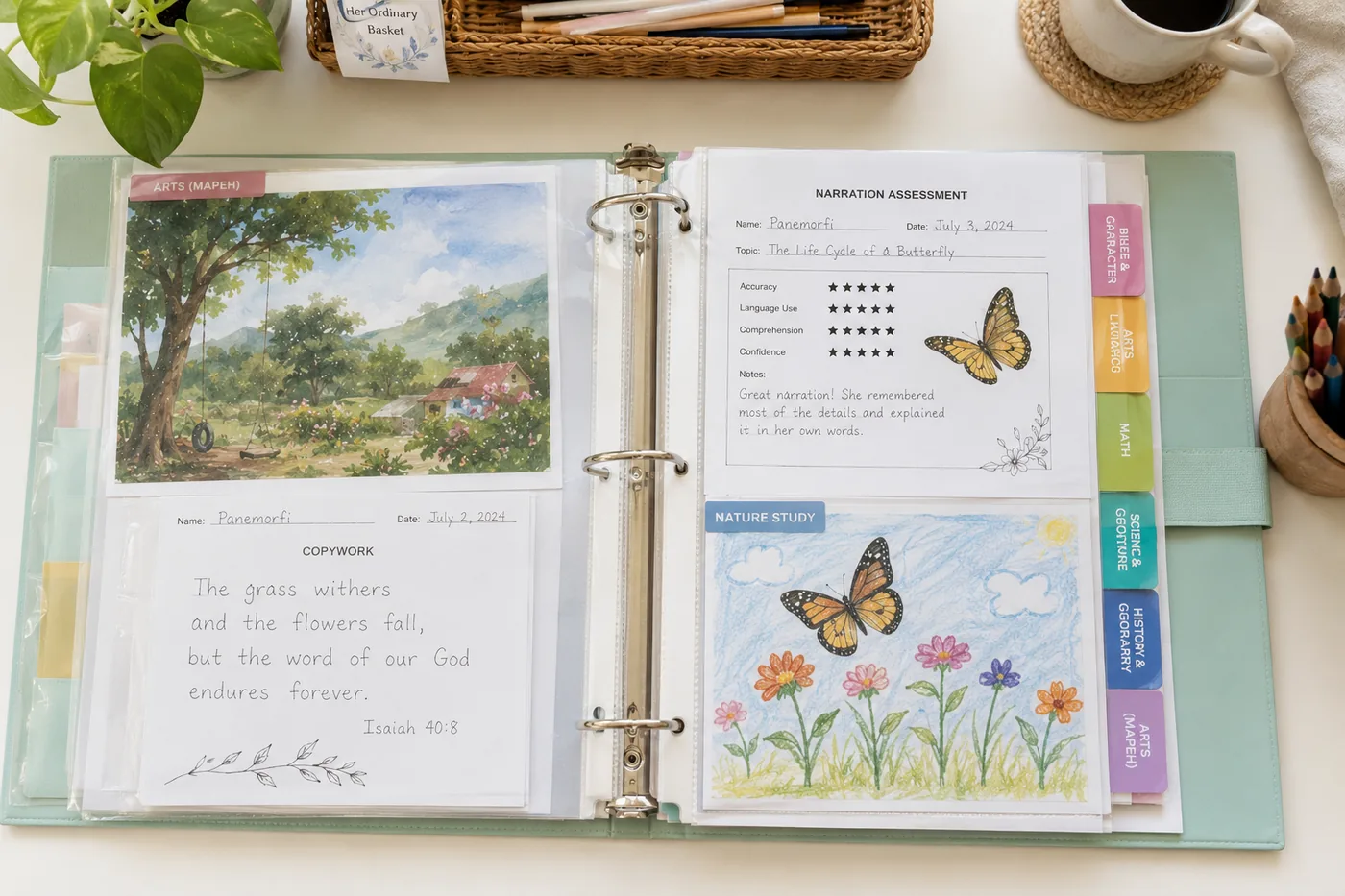
- Narration. Instead of a worksheet or quiz, your child tells back what she just heard, in her own words. It sounds simple; it's a far more honest measure of understanding than a fill-in-the-blank ever was.
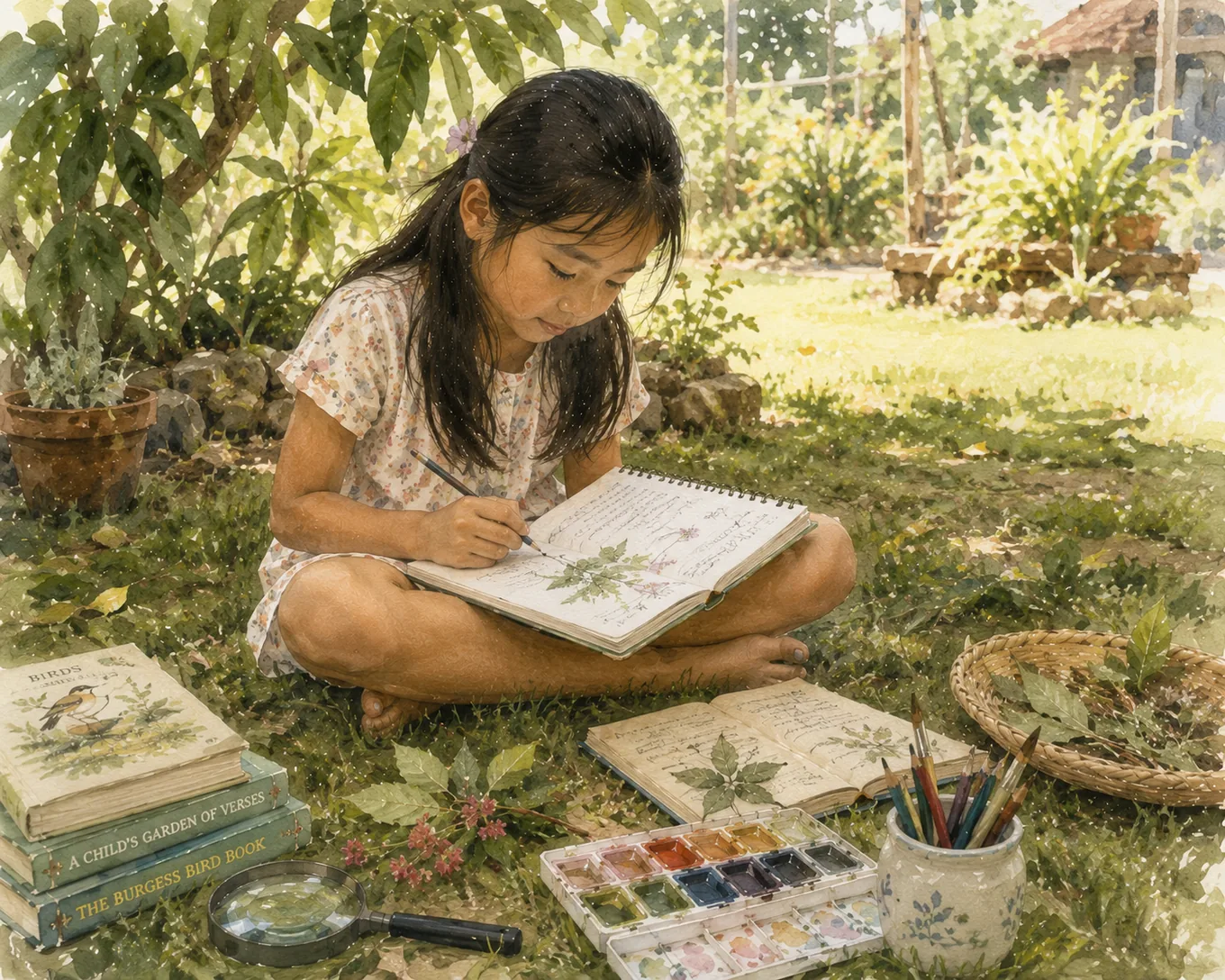
- Nature study. Real time outdoors observing and sketching something living — a spider, a leaf, a bird — in a nature journal. In the Philippines, the biodiversity right outside your door makes this almost effortless.
- Copywork & a wide feast. Handwriting beautiful lines worth keeping, plus picture study, music, poetry, and handicrafts — what Mason called a “wide and generous feast.”
For Filipino families, it fits more naturally than it first appears. Reading real picture books aloud does double duty for English comprehension without the artificiality of a language drill; nature study costs nothing and is everywhere; and the emphasis on short lessons and unhurried afternoons suits a home where real life is already happening. It feels gentle — but don't mistake gentle for shallow. If you want the full picture of what this looks like in an actual Filipino home, I wrote a deeper guide here: Charlotte Mason Homeschool Philippines: What It Is and How It Works.
Classical Education. Built on the “trivium,” which has three stages. The grammar stage focuses on memorization and facts, the logic stage builds reasoning and connections, and the rhetoric stage teaches kids to express ideas persuasively. Schools like Angelicum in the Philippines use this approach. It's academic and structured, sometimes including Latin or logic components.
Montessori. Child-led and hands-on, with emphasis on independence and practical life skills. Very popular for preschool through early elementary. Kids work at their own pace using self-correcting materials.
Unit Studies. You pick one big theme — say Philippine history or ecosystems — and connect all subjects through it. Perfect for families with kids at different grade levels, because everyone can engage with the same topic from different angles.
Unschooling. The most child-led approach of all. You follow your child's interests and let those interests drive the learning. This requires a high level of trust in the process and isn't for everyone, but some Filipino families swear by it.
Then Choose a Provider That Actually Follows Your Method
Here's the step most guides skip entirely, and it's the one that saves you a whole year of quiet frustration. Once you've fallen for a method, you need a provider whose program actually reflects it. This matters most if you're going provider-based, but even many indie families lean on a provider's framework to stay compliant. A Charlotte Mason family who enrolls under a heavily textbook-and-test provider will spend the entire year fighting the curriculum instead of enjoying it. Method first, then find the provider that already speaks your language.
The honest catch: there is no single official directory that lists every homeschool provider neatly sorted by method. So here's how to actually find one and make sure it's legitimate.
Where to look
- Ask the community first. Filipino homeschooling Facebook groups are the fastest way to find providers by method. Search the group for your method (“Charlotte Mason provider,” “Montessori homeschool,” and so on) and read the real, unfiltered reviews from parents already enrolled.
- Read the provider's own website. A provider that's serious about a method will say so plainly — look for a page describing their philosophy, sample schedules, and booklists. If a provider can't tell you what educational philosophy they follow, that's an answer in itself.
- Start from DepEd. Homeschool providers must be DepEd-recognized private schools operating under DepEd Order No. 001, s. 2022. The official DepEd website (deped.gov.ph) is your reference point for the rules, and the DepEd Regional and Division Office directories listed there are how you confirm a school is real and recognized.
How to verify a provider is legitimate
Before you send anyone a single peso, confirm they're actually accredited — this is the step that protects your child's records.
- Ask for their DepEd recognition. A legitimate provider will have a government permit or recognition number for the levels they offer. Ask for it directly; a real school will hand it over without hesitation.
- Cross-check with the DepEd Division Office. Contact the DepEd Division Office that has jurisdiction over the provider's registered address and confirm the school is recognized and in good standing. Contact details for every regional and division office are published on deped.gov.ph.
- Confirm the records they issue. Make sure the provider issues official report cards (Form 138) and the records your child will need to transfer or move on to the next level.
Questions to Ask Before You Enroll
Copy these into a message and send them to any provider you're considering. Their answers — and how willingly they answer — tell you almost everything.
- Which educational method or philosophy does your program follow (Charlotte Mason, Montessori, classical, traditional)?
- Are you DepEd-recognized, and what is your permit or recognition number?
- What exactly is included in the annual fee, and what costs extra?
- How much Homeschool Coordinator support do we get, and how often?
- What are your assessment, portfolio, and reporting requirements?
- Can we adapt the curriculum or supplement it with our own books?
- Will our records transfer smoothly if we move to a traditional school later?
- How do re-enrollment, graduation, and PEPT support work?
What DepEd Actually Requires From You
Regardless of which pathway or method you choose, there are non-negotiable requirements from DepEd's official guidelines that every homeschooling family must follow.
Your child must:
- Follow the K to 12 Basic Education Curriculum.
- Take the National Achievement Test (NAT) and, at the appropriate level, the National Career Assessment Examination (NCAE).
- Take the Philippine Educational Placement Test (PEPT) or enroll in a DepEd-accredited school if they want an official diploma or certificate of completion.
The 1987 Philippine Constitution, as noted by the Official Gazette of the Philippines, affirms the natural right of parents to educate their children, which is the legal foundation homeschooling rests on. But that right comes with the responsibility of ensuring your child still meets national educational standards.
If you're going the provider-based route, your school handles most of this documentation. If you're indie homeschooling, you'll want to build a portfolio system from day one.
Time, Cost, and the Reality of Daily Homeschooling Life
Let's talk numbers. For most grade levels, focused homeschool lessons take about 2 to 4 hours per day. Older students doing high school level work might need 3 to 5 hours. That is it. The rest of the school day in a traditional setup? A lot of it is waiting, transitioning between subjects, and managing a classroom of 40 kids.
As for costs, it varies widely. Provider-based programs range from ₱20,000 to ₱100,000 per year. Indie homeschooling can cost significantly less if you're resourceful, though you'll still spend on materials, books, and possibly co-op memberships.
The Philippine Statistics Authority reports that average household spending on education in the Philippines continues to rise, which is part of why many families see homeschooling as a cost-effective long-term option when managed well.
One thing I want to be upfront about: homeschooling is not easier than traditional school. It's a different kind of hard. You're the teacher, the scheduler, the record-keeper, and the person who has to explain long division while also answering work emails. Time management becomes your most important skill. (If the sheer weight of it is what's scaring you, I made a free, gentle guide for exactly that feeling: Homeschooling Without the Overwhelm.)
Things to Know
- You don't need to be a licensed teacher to homeschool in the Philippines. Parents act as the primary teaching agents, supported by a school-assigned Homeschool Coordinator if you're in a provider-based program.
- Not all homeschool providers are created equal. Research reviews, ask in Filipino homeschooling communities, and confirm the provider is actually recognized by DepEd before paying any fees.
- Socialization is a real concern worth addressing intentionally. Homeschooled kids in the Philippines often join co-ops, sports leagues, parish groups, or community learning pods to stay connected with peers.
- Your method can evolve. Plenty of families start with traditional textbooks and shift to Charlotte Mason or unit studies after a year. You're allowed to change your mind.
- High school homeschoolers need to plan ahead for college entrance requirements. Most Philippine universities accept homeschool graduates, but requirements vary, so check directly with CHED-recognized institutions.
- DepEd's requirements around the PEPT and NAT mean assessments are unavoidable. Build test preparation into your curriculum starting at least a year before those exams.
Frequently Asked Questions
Do I need a teaching license to homeschool my child in the Philippines?
No, you do not need a professional teaching license to homeschool in the Philippines.
DepEd recognizes parents as the primary teaching agents in a homeschool setup. For provider-based homeschooling, a school-assigned Homeschool Coordinator provides additional support and oversight, but the day-to-day teaching is done by you.
How do I find a homeschool provider that follows a specific method?
Start in Filipino homeschooling Facebook communities, search the group for your method, and read reviews from enrolled parents. Then check each provider's website for a stated educational philosophy, and confirm the school is DepEd-recognized before enrolling.
There's no single official directory sorted by method, so community recommendations plus DepEd verification (via deped.gov.ph and your local DepEd Division Office) are the reliable combination.
How does my homeschooled child get an official diploma in the Philippines?
Your child can earn a DepEd-recognized certificate by taking the Philippine Educational Placement Test (PEPT) or by enrolling in a DepEd-accredited school for validation.
If your child is in a provider-based program, the accredited school typically issues the official records. Indie homeschoolers will need to go through the PEPT route, so it's worth planning for this well in advance of graduation.
Can my homeschooled child still get into a Philippine university?
Yes, most Philippine universities accept homeschool graduates, though each institution sets its own admission requirements.
It's a good idea to contact your target schools directly to clarify what documentation they need. Many homeschool graduates take college entrance exams just like traditionally schooled students.
What is the best homeschooling method for beginners in the Philippines?
For most first-time homeschooling parents, the traditional or textbook-based method is the easiest entry point because it mirrors what parents already know from their own schooling.
That said, many Filipino families gradually shift to Charlotte Mason or unit studies once they get comfortable. The “best” method is ultimately the one your child responds to and that you can sustain as the parent-teacher.
How much does homeschooling cost per year in the Philippines?
Costs vary significantly: provider-based programs typically range from ₱20,000 to ₱100,000 per year, while indie homeschooling can be considerably lower depending on the materials you choose.
Beyond enrollment fees, factor in textbooks, supplemental materials, co-op memberships, and any extracurricular activities. Some families also invest in online courses or curriculum subscriptions, which add to the total.
The Bottom Line on How to Homeschool in the Philippines
Understanding how to homeschool in the Philippines comes down to three things: knowing your legal options, choosing a method that fits your family, and then finding a provider who actually follows it. It won't always look like the Pinterest-perfect homeschool room with color-coded binders. Some days it's your kid narrating a lesson while you're both still in pajamas, and that's okay too.
The Department of Education's official homeschooling resources are your starting point for getting registered and compliant. From there, connect with a local homeschooling community, whether that's an online group, a co-op in your barangay, or even just one other homeschooling family nearby. That support network will matter more than any curriculum you choose.
Your next step: decide whether provider-based or indie homeschooling fits your situation, then reach out to at least two DepEd-accredited providers this week for enrollment details — and ask each one which method they follow.
walk with us
Once-a-week notes, book finds, and free printables for fellow Filipino homeschoolers.
Join the Community