Charlotte Mason Homeschool Philippines: What It Is, How It Works, and Whether It's Right for Your Family
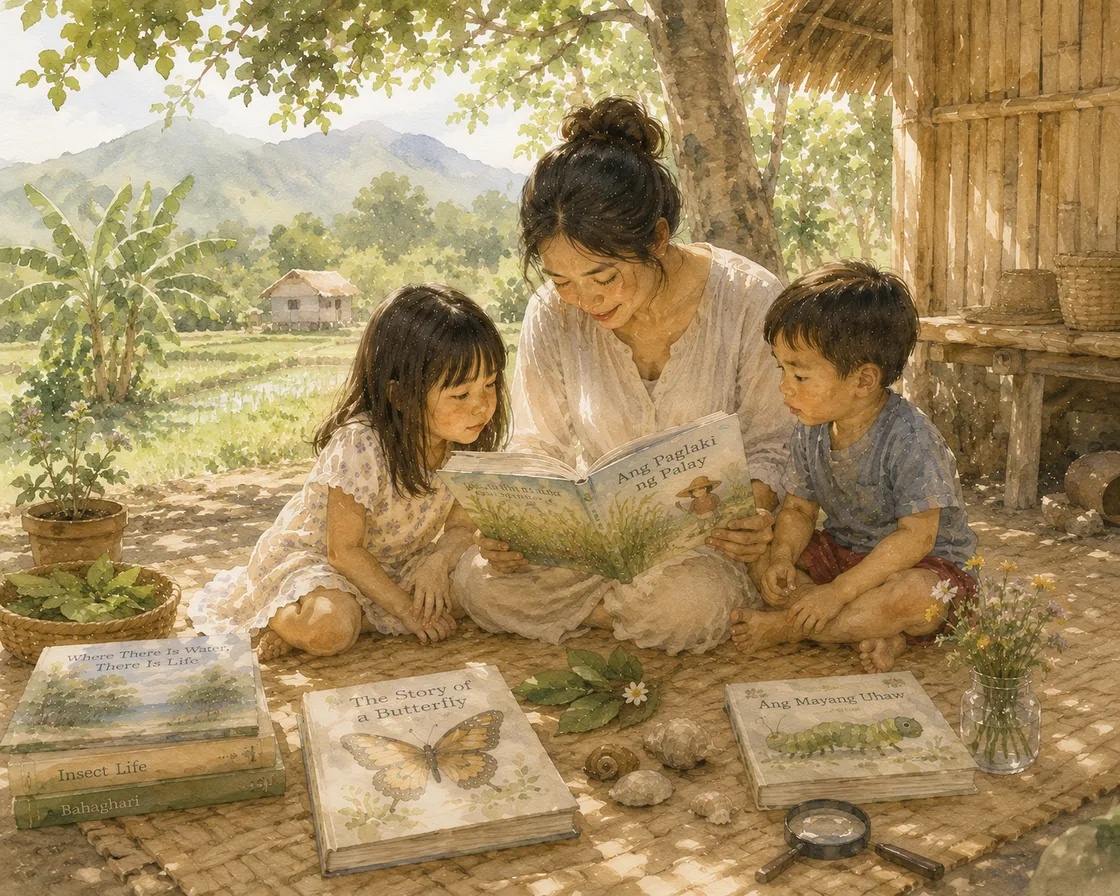
Charlotte Mason homeschool Philippines is a method rooted in treating your child as a full person right now, not a project to be completed later. It replaces worksheets and rote memorization with living books, narration, nature study, and short focused lessons that actually respect how children's minds work.
Key Takeaways
- Charlotte Mason's core idea is that children are persons with real intellectual and moral lives, not empty vessels waiting to be filled.
- Living books replace textbooks: real literature written by people who are passionate about their subject, not dumbed-down summaries.
- Narration (having your child tell back what they heard) is the primary assessment tool. No quizzes, no comprehension worksheets.
- DepEd requires enrollment at Kinder 2 (age 5), so most Philippine CM providers build their curriculum around that requirement.
- Recommended daily learning time ranges from 1–2 hours for Kinder up to 4–5 hours for high school students.
- A growing community of Filipino CM practitioners makes it far easier to start today than it was a decade ago.
The Philosophy That Started Everything (and the Book Behind It)
Before there were curriculum packages, Facebook groups, or Shopee cart checkouts filled with nature journals, there was one book that accidentally launched a movement. Susan Schaeffer Macaulay published For the Children's Sake in 1984. It was not written from an academic theory chair. Macaulay had a toddler in London, people kept asking where she planned to send her to school, and every school she visited was loud, crowded, and grim. Bad behavior, bad outcomes, and zero respect for the child as an actual person. She went looking for an alternative and found Charlotte Mason, a Victorian-era British educator (1842–1923) that most of the world had completely forgotten. Her book was an attempt to hand that discovery to the rest of us, and it became the founding text of the modern Charlotte Mason homeschool movement almost by accident.
The one idea everything else hangs on: your child is a person right now. Not raw material you are shaping into a future person. Not a blank page you fill with facts. But here is the part people often skip over: Macaulay is also blunt that leaving a child alone to “unfold naturally” is just as wrong. Her actual framing is closer to this: education is the provision of possibilities for a person to build relationships with a vast number of things and thoughts. Your job is not to pour knowledge in, and it is not to step aside. It is to keep introducing your child to a wide, rich world and let her form her own relationship with it. That reframe changes what teaching even means. You are not the source of the river. You are the one who keeps walking the horse to different rivers, over and over again.
What “Living Books” Actually Means (and What It Rules Out)
Charlotte Mason had a word for the alternative to living books: twaddle. Macaulay uses it like a scalpel. Twaddle is dumbed-down material, the watered-down retelling, the cartoon version of a historical event, the workbook that assumes a six-year-old cannot handle something real. Mason's position, which Macaulay seconds enthusiastically, is that children do not need protecting from real books, real art, and real ideas. They rise to what you actually give them.
This means you hand your child a beautifully illustrated picture book about Magellan, not a photocopy worksheet with fill-in-the-blank sentences. It means you read poetry written by actual poets, not rhymes composed by a curriculum writer trying to hit a reading level. It also means that for Filipino families where English is a second language, reading real picture books aloud together does serious double duty: it builds genuine comprehension and lays a strong foundation for the language that most CM resources are written in, without the artificiality of a language drill.
According to the Philippine Department of Education (DepEd), children must be enrolled by Kinder 2 (age 5). Most Philippine CM providers build their curriculum timeline around that requirement, and formal academics in a CM framework don't start pushing reading and writing intensively until age 6 because psychomotor skills are still developing at five. That alignment with child development is one reason families find CM such a natural fit.
Narration: The Assessment Tool That Replaces the Quiz
Here is the mechanism underneath all the philosophy. After you read something aloud once, with no re-reading, your child tells it back in her own words. No comprehension worksheet. No multiple-choice items with bubbles to fill. Think about why this works: when you finish a novel, nobody gives you a pop quiz to verify you read it. You talk about it because you actually engaged with the story. Narration asks for that same real engagement instead of test-taking behavior.
It also does something quietly significant: it makes the child's attention the whole game. She only gets one pass at the material, so she has to actually listen. Mason and Macaulay both treat attention as close to the master skill of an educated mind. The habit of attention is what makes every other subject possible. When a child knows narration is coming, she is not passive. She is actively organizing what she hears, which is a far more sophisticated cognitive task than circling the right answer on a worksheet.
For Filipino parents raised in a traditional classroom system, this can feel counterintuitive at first. You might worry there is no way to “measure” what your child learned. But narration is a far more honest measurement than a test: a child cannot narrate clearly what she did not actually understand, and she cannot hide confusion behind a lucky guess.
How Charlotte Mason Homeschool Philippines Works in Practice
The daily schedule in a CM home looks very different from a traditional school day. Lessons are short and focused: 15 to 20 minutes per subject for younger children, longer as they grow. The schedule rotates through subjects quickly to keep attention fresh rather than grinding through a single subject for an hour until everyone loses the will to live.
Here is a general breakdown of recommended daily learning time used by CM providers in the Philippines:
| Grade Level | Recommended Daily Learning Time |
|---|---|
| Kinder | 1–2 hours |
| Grades 1–3 | 2–3 hours |
| Grades 4–5 | 3–4 hours |
| High School | 4–5 hours |
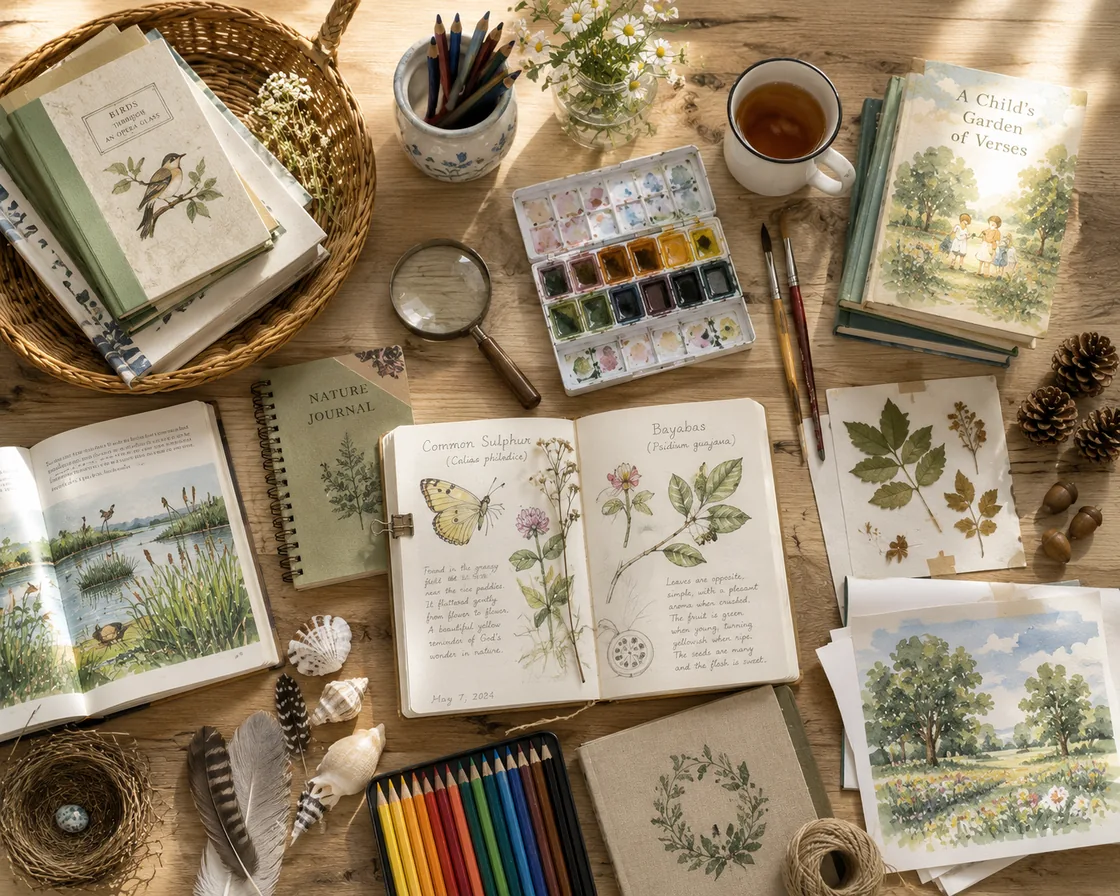
Nature study is a non-negotiable pillar. This is not a nature documentary and a worksheet. This is your child sitting outside (your backyard, a park, the shores of Laguna de Bay) observing something real, sketching it in a nature journal, and recording what she notices. For Filipino families, this is actually an enormous advantage: the biodiversity here is staggering, and the natural world outside your window is a living classroom that no imported curriculum can compete with. In our little garden alone, we have already journaled at least 7 species of spiders, 4 species of grasshoppers, 8 species of butterflies, and so much more!
The World Health Organization's research on outdoor learning and children's health reinforces what CM practitioners have known for over a century: children who spend time outdoors in unstructured observation develop stronger focus and better physical health outcomes.
Finding Your Community (and Your Resources) in the Philippines
One of the biggest fears for new homeschooling parents is isolation, and it is a reasonable one. But the CM community in the Philippines has grown significantly in recent years. There are Facebook groups, local co-ops, and dedicated providers like Living Learning Homeschool specifically built to serve Filipino families using this method.
For curated resources and a genuine sense of what this looks like in an actual Filipino home, Her Ordinary Basket is one of the more honest and warm corners of the Philippine CM internet. The about page gives you a clear sense of the person and philosophy behind it, which matters when you are deciding whose guidance to trust. If you are looking for physical materials to support your CM journey, the shop carries carefully chosen items that align with the method. For ongoing reading, the journal is worth bookmarking: it covers practical CM topics written from a Filipino perspective. If you want to connect with other families doing the same thing, the community section is the right place to start. And if you have specific questions, the contact page is there for exactly that.
For legal requirements, DepEd's official homeschool program guidelines lay out what documentation families need and how to register properly. And if you're still weighing your options before committing to a method, our broader starter guide walks through everything: How to Homeschool in the Philippines — the legal pathways, methods, costs, and how to choose a provider.
Things to Know
- DepEd requires enrollment at Kinder 2 (age 5), and most Philippine CM providers structure their curriculum to meet this requirement from the start.
- CM does not mean unschooling. There is structure, there are schedules, and there are clear expectations. The difference is in the method and materials, not the absence of accountability.
- “Living books” does not mean exclusively English books. Filipino CM families successfully use Filipino-language picture books and literature, especially in the early years.
- Narration can be oral, written, or illustrated depending on the child's age and strength. A six-year-old narrates verbally. An older child might narrate through a written retelling or a drawing.
- The Philippine Statistics Authority data on homeschooling enrollment shows a steady increase in registered homeschoolers since the pandemic years, which has also expanded the pool of local CM mentors and co-ops.
- You do not need to spend a fortune to start. Many living books can be found secondhand at BookSale branches across Metro Manila and other cities for as little as ₱50–₱150 per book.
What the “Education Revival” Actually Means for Filipino Families
There is a reason Charlotte Mason's ideas are experiencing a major resurgence right now. Families who have watched their children disengage from worksheet-heavy approaches are actively looking for something different, and CM offers a coherent alternative with a clear theoretical foundation and a century of practical testing behind it.
A report from Rappler on alternative education trends in the Philippines notes that pandemic-era homeschooling revealed how many families felt the traditional school system was not meeting their child's actual learning needs. CM gives those families a framework that is rigorous without being punishing, structured without being mechanical, and deeply respectful of the child as a real intellectual being.
The Inquirer's coverage of Filipino homeschooling families has featured stories of parents who started with zero teaching background and found CM manageable precisely because it does not require you to be an expert in every subject. Your job is to be a guide who provides rich material and gets out of the way of real engagement.
Frequently Asked Questions
Does Charlotte Mason homeschool Philippines comply with DepEd requirements?
Yes, CM homeschooling can be fully compliant with DepEd regulations when you register under the DepEd Alternative Learning System or an accredited homeschool provider.
Most Filipino CM providers are familiar with DepEd enrollment requirements and design their programs to meet them. The key is ensuring your child is enrolled by Kinder 2 at age 5, as required by law. Your chosen CM provider should guide you through the documentation process.
How much does it cost to homeschool using the Charlotte Mason method in the Philippines?
Costs vary widely, from as low as ₱5,000 per year for a DIY approach using secondhand books to ₱30,000–₱60,000 or more per year with a full-service CM curriculum provider. With our homeschool provider, we paid around ₱24,000.
Many families find a middle path: using a CM provider for structure and accountability while sourcing living books independently through BookSale, online secondhand groups, or libraries. The method itself does not require expensive materials.
What age should I start Charlotte Mason homeschooling with my child?
You can begin introducing CM principles from birth through read-alouds and nature observation, but formal structured lessons typically begin at age 6 in a CM framework.
Before age 6, the focus is on reading aloud together, outdoor play, and building a love of books and nature. Psychomotor skills are still developing in the early years, so CM intentionally delays formal writing and reading instruction.
Do I need to be an experienced teacher to use the Charlotte Mason method?
No. CM is specifically designed for non-professional educators and has been used successfully by parents with no teaching background for decades.
The method provides a clear framework: read aloud from living books, ask for narration, go outside regularly, and keep lessons short. Many Filipino CM providers also offer training series and coordinator support specifically for parents who are new to both homeschooling and the CM method.
Can Charlotte Mason homeschool Philippines work for children who struggle with traditional school?
Yes, and many families turn to CM precisely because a child has been disengaging, struggling with attention, or losing interest in school entirely.
The short lessons, oral narration, and nature-based components often help children who find long seated tasks difficult. Because CM does not rely heavily on worksheets, children who struggle with writing mechanics can still demonstrate genuine comprehension and intellectual engagement through other means.
Where Charlotte Mason Homeschool Philippines Takes You From Here
Charlotte Mason homeschool Philippines is not a trend to chase or a philosophy to admire from a distance. It is a practical, tested method that Filipino families are using right now, in apartments in Quezon City, in houses in Cebu, and on sprawling lots in the provinces. The community exists, the resources exist, and the legal framework for doing this properly exists.
Your action step is simple: pick one living book, read it aloud to your child tonight, and ask them to tell you what happened. No quiz, no worksheet. Just listen to what they noticed. That single exchange will tell you more about how this method works than any article ever could.
walk with us
Once-a-week notes, book finds, and free printables for fellow Filipino homeschoolers.
Join the Community