The Case of the Borrowed Words
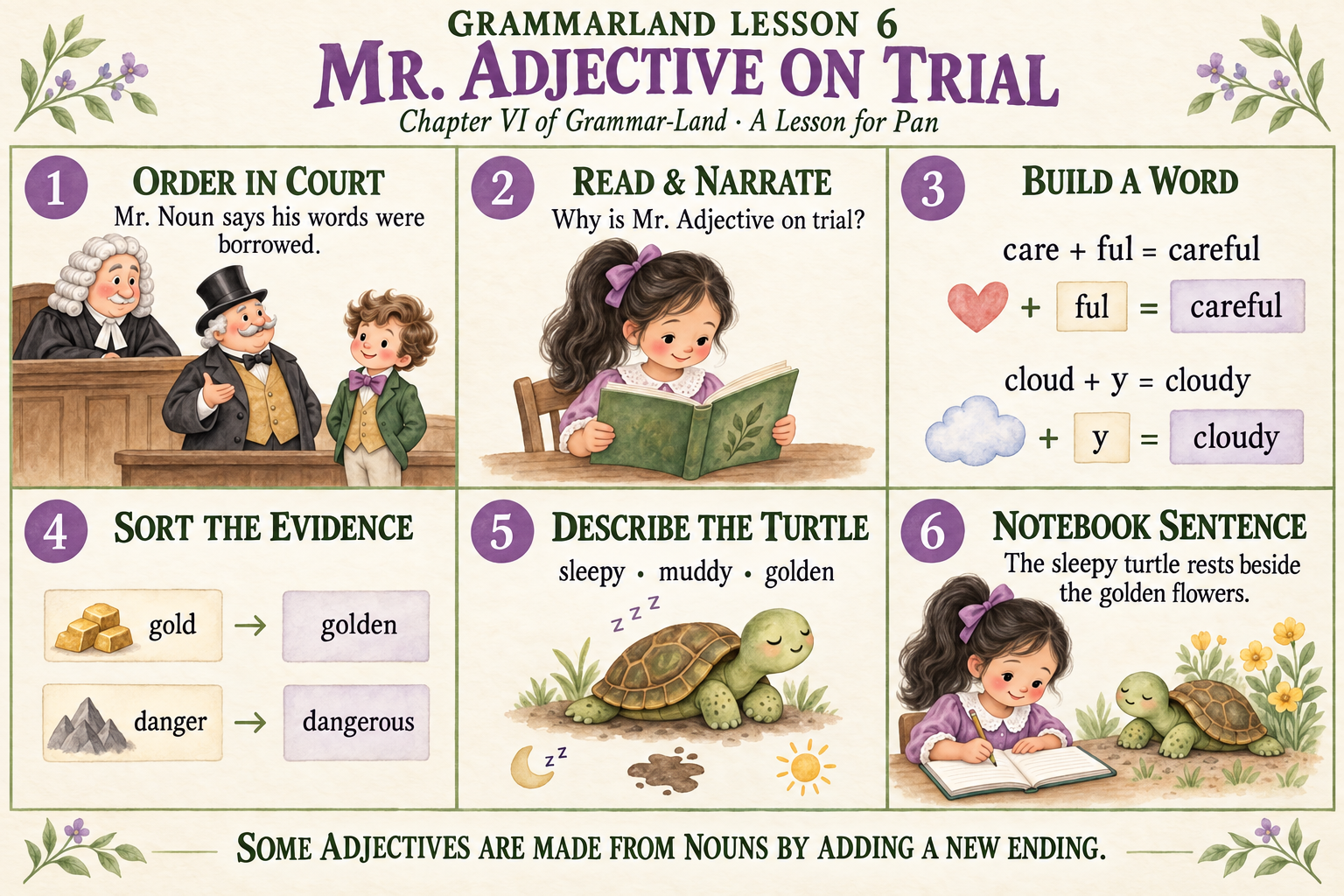
In Chapter VI of Grammar-Land, after meeting Talkative Mr. Adjective, we returned to the courtroom expecting more of his colourful descriptions. Instead, we found him standing before Judge Grammar, accused of stealing.
Rich Mr. Noun insists that words such as care, hope, gold, and danger belong to him. Yet Mr. Adjective has been seen using careful, hopeful, golden, and dangerous. Has he truly stolen Mr. Noun’s property, or has he borrowed the words and given them a new job?
Chapter VI gave us a playful way to notice word families without turning the lesson into a list of suffixes. Pan did not need to memorise every ending Mr. Adjective uses. She only needed to discover that two related words can come from the same root while doing different work in a sentence.
Our Objective
By the end of the lesson, Pan began to notice that some adjectives are formed from nouns by adding a new ending:
- care becomes careful
- hope becomes hopeful
- danger becomes dangerous
- gold becomes golden
- cloud becomes cloudy
- sleep becomes sleepy
The goal was not to learn the names of the endings. It was to hear the family resemblance and see how the new word begins describing a noun.
What You’ll Need
- The Grammarland book
- Rich Mr. Noun and Talkative Mr. Adjective character cards
- A toy turtle
- A small envelope marked Evidence
- Noun and adjective word cards
- Small paper endings: -ful, -y, -ous, and -en
- A nature notebook and coloured pencils
The Step-by-Step Lesson
1. A summons from Judge Grammar
Before opening the book, I placed Rich Mr. Noun and Talkative Mr. Adjective on the table with an envelope between them.
“Order in Grammarland! Mr. Adjective has been summoned to court. Rich Mr. Noun says some of his words have been stolen.”
Inside the envelope were six noun cards:
care · hope · danger · gold · cloud · sleep
Then I revealed Mr. Adjective’s words:
careful · hopeful · dangerous · golden · cloudy · sleepy
I asked Pan whether any of the words looked as though they belonged to the same family. I let her examine them without explaining the endings yet.
2. Read the courtroom story
We read Chapter VI, Mr. Adjective Tried for Stealing, straight through. The chapter offers many examples of nouns that have been changed into adjectives. At five, Pan did not need to study every example. The words were simply evidence in the courtroom case.
3. Narration
After reading, I closed the book and asked:
“Why was Mr. Adjective brought to court?”
If your child needs a little help beginning, you might ask:
- Who accused Mr. Adjective?
- Which words did he borrow?
- What did he add to the words?
- How did the words change?
The important idea is that Mr. Adjective took words connected to nouns and changed them so they could describe.
4. Build an adjective
I placed the noun card care on the table and handed Pan the ending -ful. She joined the two cards:
care + ful = careful
We said both words aloud. Care is a noun. Careful tells us what someone or something is like.
Then we built a few more:
| Noun | Add an ending | Adjective |
|---|---|---|
| hope | + ful | hopeful |
| cloud | + y | cloudy |
| sleep | + y | sleepy |
| danger | + ous | dangerous |
| gold | + en | golden |
Four or five transformations were enough. We stopped while the word-building still felt like discovery.
5. Describe the turtle
Our turtle returned for the next activity. I placed several adjective cards beside it:
sleepy · careful · muddy · golden · playful
Pan chose different words to describe the turtle:
- A sleepy turtle
- A careful turtle
- A muddy turtle
- A golden turtle
- A playful turtle
We used a few of them in complete sentences. Some descriptions were realistic and others were wonderfully imaginative. Both helped her hear the adjective doing its new job beside a noun.
6. Sort the evidence
We placed the character cards for Rich Mr. Noun and Mr. Adjective on opposite sides of the table, then returned each piece of evidence to its owner.
| Rich Mr. Noun | Mr. Adjective |
|---|---|
| care | careful |
| hope | hopeful |
| cloud | cloudy |
| sleep | sleepy |
| danger | dangerous |
| gold | golden |
The words are related, but they are doing different work. Mr. Noun gives us the name or idea. Mr. Adjective uses the changed word to tell us more about a noun.
7. Look for word families outdoors
We took the turtle into the garden and looked for a few word families in the world around us:
- mud becomes muddy
- cloud becomes cloudy
- sun becomes sunny
- wind becomes windy
- rain becomes rainy
- thorn becomes thorny
We chose only two or three. The fun was in hearing how the noun changed when it began to describe something.
8. The notebook sentence
Back inside, Pan drew the turtle in the garden. Together, we wrote:
The sleepy turtle rests beside the golden flowers.
She underlined sleepy and golden, the two words that tell us more about the turtle and the flowers. For a child who is still beginning to write, the shorter phrase a sleepy turtle is enough.
The Memory Sentence
Some adjectives are made from nouns by adding a new ending.
We followed it with one spoken example: Cloud becomes cloudy.
The word some matters. Not every adjective is made from a noun, so this lesson introduces a useful pattern without turning it into a rule that does not always hold.
A Gentle Twenty-Minute Lesson
- Courtroom invitation: 2 minutes
- Read the chapter: 8 to 10 minutes
- Narration: 3 minutes
- Build-an-adjective activity: 5 minutes
- Turtle sentence: 2 minutes
The outdoor word hunt and notebook drawing can be completed later in the day.
Ending the Lesson
We returned the word cards to the evidence envelope and let Judge Grammar announce:
“Mr. Adjective may have borrowed these words from Mr. Noun, but he has changed them and given them a new job. The court will continue to watch him very carefully.”
Then we placed Mr. Noun and Mr. Adjective beside each other on the Grammarland map. Their words may come from the same family, but each character has his own work to do.
the free printable pack
Rich Mr. Noun and Talkative Mr. Adjective are both inside our free Grammarland pack, together with the full-colour map, all nine character cards, and a black-and-white map for colouring.
Get the free Grammarland packKeeping the Story Alive
During the week, listen for one small word family at a time:
“Rain and rainy sound related. Which one belongs to Mr. Noun, and which one works for Mr. Adjective?”
There is no need to examine every describing word. The fun is in catching Mr. Adjective borrowing another word and discovering what he has done to it.
Why We Teach Grammar This Way
A worksheet can show a child that -ful or -y has been added to a word. The courtroom story gives the change a reason to be remembered. Mr. Noun calls for justice, Mr. Adjective defends his borrowed words, and Pan becomes one of the investigators examining the evidence.
The grammar grows out of a relationship between words. She hears that cloud and cloudy belong together before she is ever asked to name a suffix. The terminology can come later. For now, she has seen words change their clothes and take up new work in Grammarland.
Visit the complete Grammarland lesson series to begin at the courtroom doors and meet each citizen in order.