Charlotte Mason Education Is Transforming Me, Too
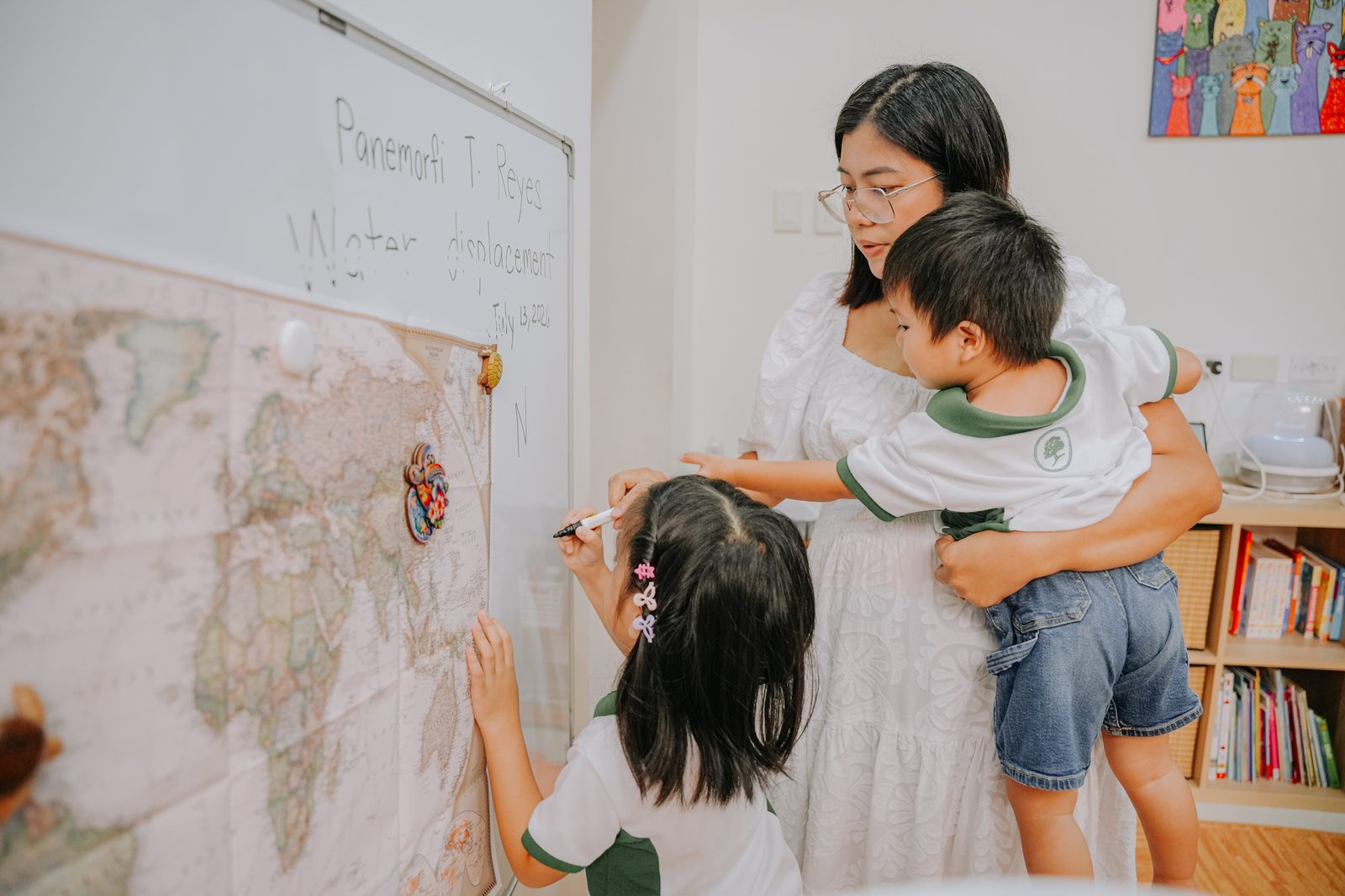
I thought I was choosing an education for my children.
I didn't realize how much it would change me, too.
We are only five weeks into homeschooling, and I am certainly not writing this as someone who has mastered the Charlotte Mason method. But even this early, there is something happening in our homeschool that I didn't expect — and it isn't happening only to my daughter.
It's happening to me.
The education I knew
I grew up in a rural area. I studied in public schools from elementary through high school, and eventually earned a CHED scholarship for college.
For a long time, that shaped the way I thought about education, and I am grateful for the education I received. It gave me opportunities. I learned skills. I learned how to work, create, and make a living — a decent living, a life with dignity and abundance.
In many ways, I felt that education had worked for me.
So naturally, when I began thinking about my children's education, I thought: Maybe they can take the same path. Or perhaps, because we are able to give them opportunities that weren't available to me, we could give them an even better one.
My husband and I were prepared to spend on a good school. We even considered moving, because there aren't many options where we live. We wanted to give our children the best foundation we could — so that someday they could build good lives of their own: happy lives, meaningful lives, lives with purpose.
Homeschooling entered the picture partly because our family travels often. And somewhere in that search, I encountered Charlotte Mason.
At first, I thought I had simply found a method of educating my children. Five weeks later, I am beginning to realize that I may also have found an invitation to continue my own education.
Not because what I learned before was insufficient — but because there is so much of the world I had never really stopped to notice.
I am learning alongside my child
I know more history today than I did five weeks ago.
Not because I sat down and decided, I need to study history — but because every day, I open these books with my child.
People who used to be nothing more than names to me are slowly finding their places in time. This happened before that. These people lived around the same time. While this was happening here, something else was happening on another part of the earth.
I can follow journeys now. I can look at a map and understand why people settled where they did — why rivers mattered, why people moved when there was drought, why civilizations grew in certain places.
History is slowly becoming less like a collection of facts I once memorized for an exam, and more like one enormous human story.
And I am enjoying it. Not because there will be a test. Not because I need a grade. Simply because I want to know what happened next.
And then there is nature. Oh, nature.
Before nature study, I could walk through our garden and barely notice most of the creatures living in it. An unfamiliar insect? Probably something I would brush away. A strange-looking bug? Maybe something I would try to remove.
But now we stop. We look. We wonder.
We have met creatures I never knew existed, even though they had probably been living around me all these years.
Now I find myself wondering why an insect looks the way it does. Why does this one resemble a thorn? Why does another look like a leaf? What does it eat? What eats it? Why is it here? What role does something so small have in this garden?
And suddenly, something I might once have considered ugly, frightening, or useless becomes fascinating.
I have started thinking differently about our food scraps and our soil — about what we plant in the garden, about native plants, about insects and butterflies and birds, about decomposition and biodiversity. I am beginning to understand how one small life supports another.
These things existed before we started homeschooling. I simply wasn't paying attention to them.
And perhaps that is one of the changes I treasure most. Charlotte Mason education is teaching my children to observe the world — but somewhere along the way, it is teaching their mother to observe it, too.
I care about things I used to overlook. And because I notice them now, I find myself becoming more grateful for their existence, more aware of the beauty that has been around me all along.
And then there are the books
I have always loved literature, so I thought this part would be familiar territory. But homeschooling has made us much more intentional about books.
I look for them. I buy them. I read them before or alongside my children.
Books I might once have passed over — because I assumed they were simply "children's stories" — now sit on our table.
And boy, oh boy. Children's books are not to be underestimated.
The good ones contain enormous ideas in stories small enough for a child to carry: courage, pride, greed, kindness, consequences, duty, friendship, sacrifice.
They aren't merely entertaining my child. Sometimes I close one of these books and realize that I needed that story, too.
I have always believed that literature can change us. That isn't new to me. What is new is how often I am encountering these ideas now, because I am intentionally placing good books before my children.
In preparing their feast, I keep finding something there for myself.
Even the way I pay attention is changing
There is another change I've noticed, and this one surprised me most of all.
For a long time, I thought of myself as a reader. But somewhere along the way, I had started reading the way I scroll.
I could move my eyes down an entire page while my mind was somewhere else entirely, and by the bottom I would have to go back, because I hadn't held on to a single word. Technically, I was reading. But was I really attending?
Sometimes even while someone was talking to me, I would realize that my thoughts had wandered somewhere completely different.
I don't think I lost my attention all at once. I think I lost it the way many of us have — a little at a time, to a screen that was always ready with something faster.
Somewhere between the reels and the fast cuts and the videos edited so tightly that there is a new image every second, my mind got used to a certain pace. Every swipe promised a small reward: a joke, a surprise, a little hit of something. And the moment a thing became slow, or quiet, or unstimulating, I felt the pull to move on to the next.
We've been trained, I think, to skip the slow parts — to speed up the audiobook, to scrub past the boring middle, to abandon anything that doesn't reward us in the first few seconds.
A garden, a map, a long chapter read aloud — these are exactly the slow, unstimulating somethings we have quietly learned to ignore.
But Charlotte Mason education keeps bringing us back to them. It asks us to stay with the story long enough to follow it, to look at the map long enough to understand the journey, to observe the garden long enough to notice what is actually happening there.
And I thought, at first, that this discipline of attention was mostly for my child.
Then we started doing narration.
I read aloud to her. Then I close the book, and she tells me what she remembers — what she understood, what stood out to her, sometimes even what she thinks about it. The method calls this narration. With Pan, I sometimes simply say, "Tell me what happened."
There is something interesting about asking another person to give her full attention: you begin to notice how much attention you are giving, too.
If I want to hear her narration, I have to follow the story myself. I have to listen. I have to notice. I have to remember. I have to be present.
I can't read three paragraphs aloud while thinking about the email I need to send later — because she might suddenly ask me something, or narrate a detail I missed, and I want to know what she's talking about.
Slowly, without meaning to, I am practicing the very thing I thought I had lost. So while my child is learning the habit of attention, her mother is relearning it alongside her.
Perhaps education is bigger than I thought
Five weeks. That's all.
I don't know what our homeschool will look like five years from now. I don't know which parts of our rhythm will change, which books will become beloved, which ideas my children will carry into adulthood, or which parts of this philosophy I will understand differently after practicing it for years.
I am still very much a beginner, and perhaps five weeks is far too early to make grand conclusions about a philosophy of education.
But I know myself well enough to recognize when something in me has begun to change.
I notice more. I wonder more. I know more names. I see connections between things that once seemed unrelated. I care about creatures I once ignored. I pay attention to stories I might once have dismissed as children's books. I can place people on a timeline who, only weeks ago, were merely distant names from a distant past.
And perhaps most importantly: the more I learn, the more aware I become of how much there still is to know.
I started homeschooling because I wanted to give my children a beautiful education. I worried whether I knew enough to give it to them.
Five weeks into Charlotte Mason education, I'm beginning to understand something I hadn't considered: perhaps one of the gifts of educating our children is that we are invited to keep learning, too.
I don't need to already know every person in history, every creature in our garden, or every idea waiting inside these books before I open them with my children. I can discover alongside them.
My children are learning to look closely at the world. And so am I. They are learning to listen. And so am I.
They are meeting history, literature, nature, geography, poetry, and ideas as living things rather than simply school subjects. And somehow, I am meeting them again, too.
Maybe that is the transformation I wasn't expecting. Not that homeschooling has made me an entirely different person in five weeks — but that it has made me look again.
At history. At books. At the tiny creatures in our garden. At the food scraps we bury in the soil. At maps and rivers and journeys made thousands of years ago. At my own ability to pay attention. At what it actually means to be educated.
I thought I was preparing a feast for my children.
I didn't realize there would be a place at the table for me, too.