“That Word Is Mine!” and Little Interjection Bursts In
Mr. Adjective has only just been released from his trial when another argument begins.
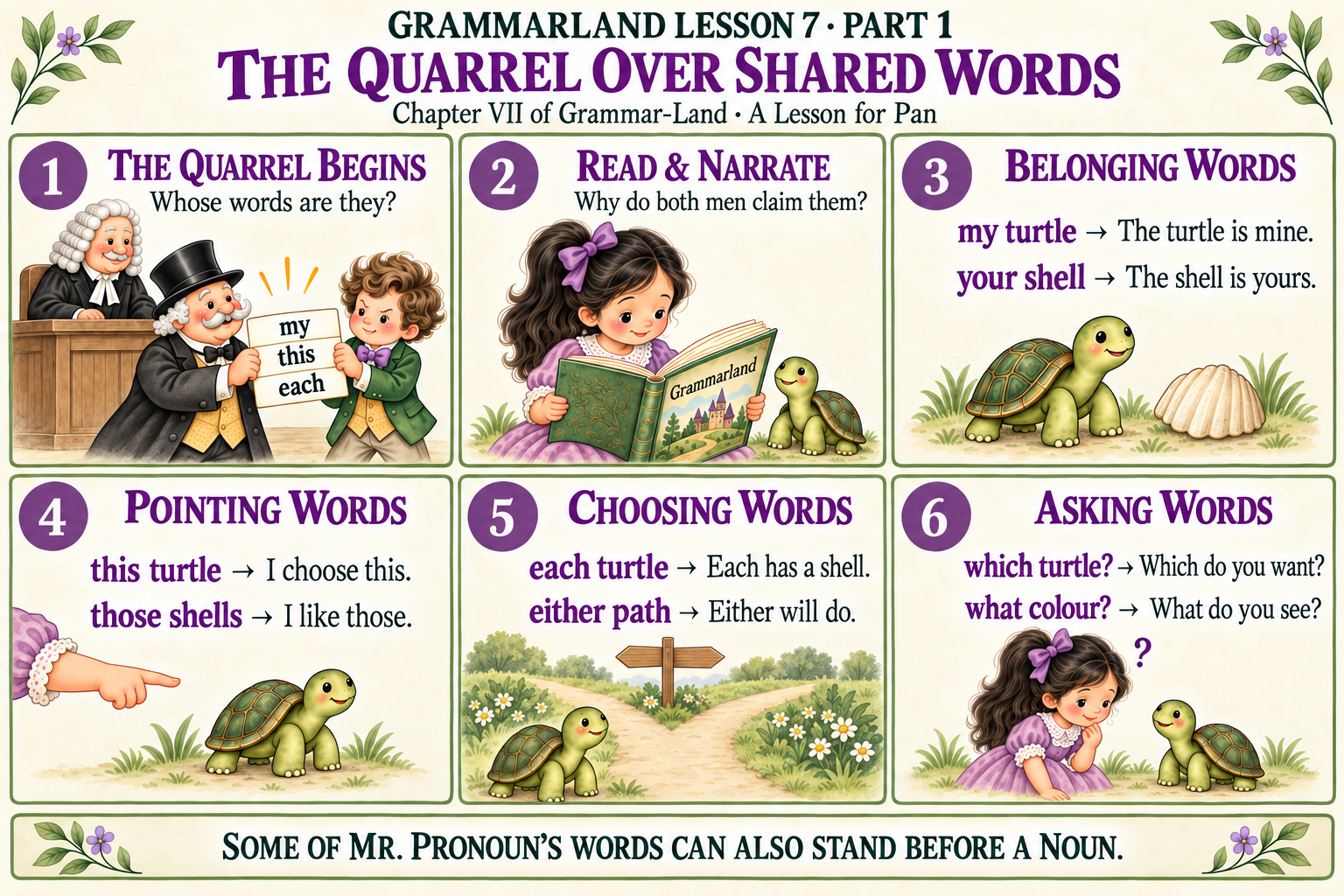
This time, Mr. Pronoun accuses him of taking far more than this, that, these, and those. They quarrel over belonging words such as my and your, choosing words such as each and either, and asking words such as which and what.
Mr. Adjective claims the words whenever they stand before a noun. Mr. Pronoun claims them when they stand alone or take a noun’s place. Both men appear to be right.
Before Judge Grammar can fully restore order, a strange little fellow bursts into court shouting, laughing, crying, and turning everything upside down. His name is Little Interjection.
Our Objective
By the end of this lesson, Pan will not be expected to remember every word in the chapter. She will simply begin to recognise four families involved in the quarrel:
| Family | With a noun | Standing alone |
|---|---|---|
| Belonging | my turtle | The turtle is mine. |
| Pointing | this turtle | I choose this. |
| Choosing | each turtle | Each has a shell. |
| Asking | which turtle? | Which do you want? |
Pan will also meet Little Interjection and discover that interjections express sudden feelings: Hooray! Oh! Alas! Ah!
The important discovery is not a list to memorise. It is that some of Mr. Pronoun’s words can also stand before a noun and help Mr. Adjective.
What You’ll Need
- The Grammarland book
- Mr. Pronoun and Talkative Mr. Adjective character cards
- A Little Interjection character card
- A toy turtle and a shell or another familiar object
- Two spaces labelled With a Noun and Standing Alone
- Four family cards: Belonging, Pointing, Choosing, and Asking
- A small selection of word cards: my, mine, this, each, and which
- Interjection cards, a nature notebook, and coloured pencils
Part 1: The Quarrel Over Shared Words
Begin with Mr. Pronoun and Mr. Adjective’s dispute. This first sitting stays with the words they both claim and the different jobs those words can perform.
1. More Than One Word Is on Trial
Place Mr. Pronoun on one side of the table and Mr. Adjective on the other. Between them, lay four cards:
MY · THIS · EACH · WHICH
Let Mr. Pronoun declare:
“These words belong to my family!”
Then let Mr. Adjective object:
“But they can stand before Mr. Noun’s words. Listen: my turtle, this turtle, each turtle, which turtle?”
Ask Pan, “Can the same family of words help both of them?” Leave the question unsettled until Judge Grammar hears the case.
2. Read the Story
Read Chapter VII, The Quarrel Between Mr. Pronoun and Mr. Adjective, and Little Interjection.
Let the longer lists wash over Pan without stopping to explain every word. The story and the quarrel matter more than remembering them all. When Little Interjection appears, let his words burst into the room:
“Hoo! Hoo! Hoo! Ha! Ha! Ha!”
His sudden entrance is part of the fun. He does not wait for an invitation; he simply throws himself into the courtroom.
3. Narration
Close the book and ask, “Why were Mr. Pronoun and Mr. Adjective both claiming the same words?”
If Pan needs help beginning, you might ask:
- What happened when a word stood before a noun?
- What happened when a word stood alone?
- How did Judge Grammar divide the words fairly?
- Which word stayed entirely with Mr. Pronoun?
- Who interrupted the court?
Let the narration follow the story. There is no need for Pan to reproduce the full list.
4. Meet the Four Word Families
Place the four family cards on the table and give Pan one representative example for each:
| Family | Words discussed in the chapter | One example to practise |
|---|---|---|
| Belonging | my, thy, his, her, its, our, your, their | my turtle / mine |
| Pointing | this, that, these, those | this turtle / this |
| Choosing | each, either, neither, one, other | each turtle / each |
| Asking | which, what | which turtle? / which? |
Tell Pan that who also appears in the chapter, but Mr. Adjective cannot place it before a noun. We do not say who turtle or who book, so who remains entirely with Mr. Pronoun.
5. Belonging Words: My or Mine?
Hand Pan the turtle and say:
This is my turtle.
Now let Pan hold it and answer:
The turtle is mine.
Continue with only a few familiar pairs:
- your shell · the shell is yours
- her basket · the basket is hers
- our garden · the garden is ours
- their stones · the stones are theirs
The book includes the older pair thy and thine. We can notice them during the reading without requiring Pan to use or memorise them.
6. The Same Word, Two Places
Now try words that keep exactly the same form. Move each card between With a Noun and Standing Alone:
| With a noun | Standing alone |
|---|---|
| this turtle | I choose this. |
| each turtle | Each has a shell. |
| either path | Either will do. |
| neither answer | Neither is correct. |
| which turtle? | Which do you want? |
| what colour? | What do you see? |
Choose only two or three rows for the spoken game. The table is here for the parent, not as a list for Pan to master in one sitting.
7. A Word Sitting on the Wall
In the book, Judge Grammar allows certain words to be shared. Grammarland calls them adjective-pronouns when they stand before a noun.
Place Mr. Pronoun and Mr. Adjective on opposite sides of a strip of paper representing a wall. When a word stands alone, place it fully on Mr. Pronoun’s side:
I choose this.
When that word stands before a noun, balance it on the wall:
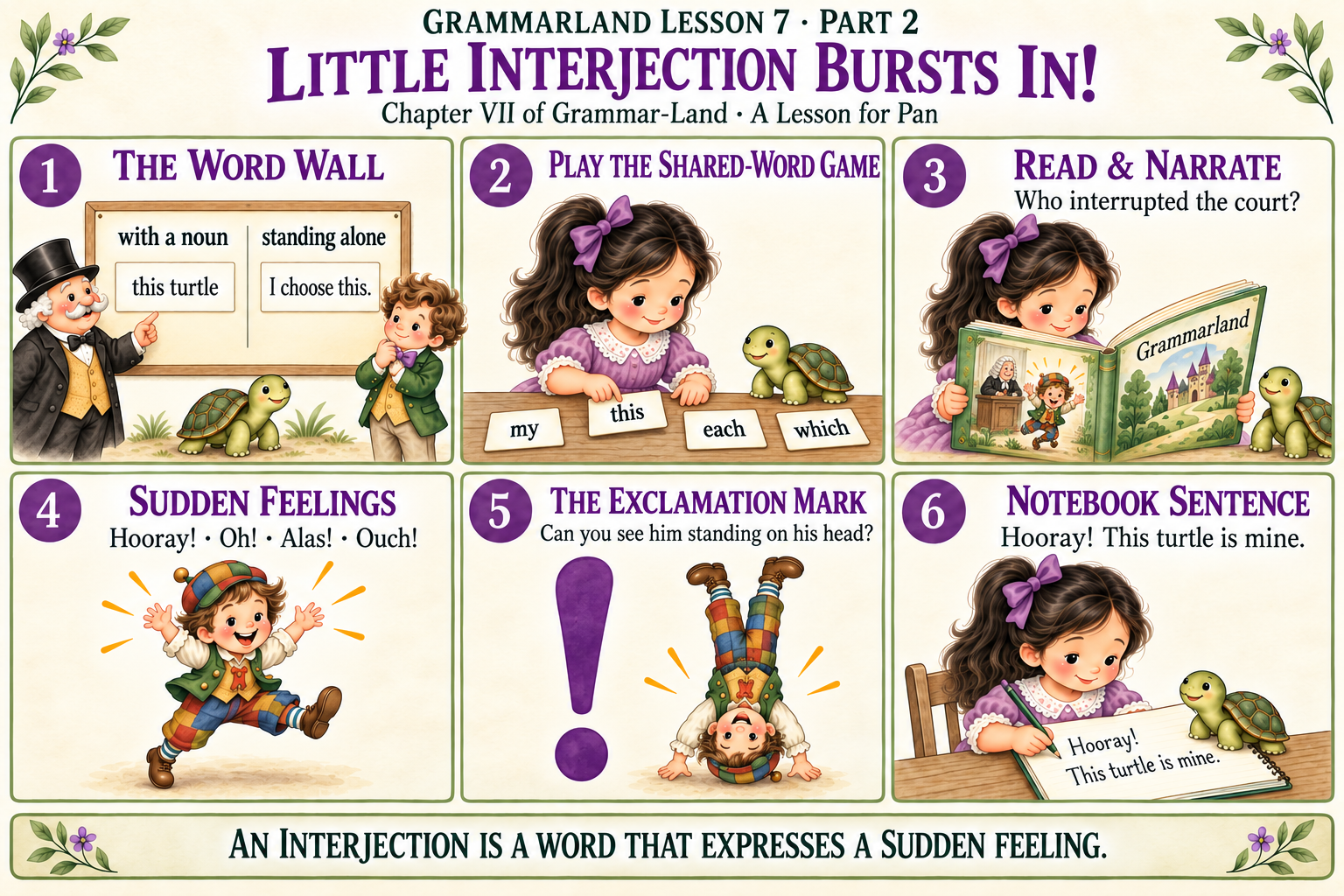
this turtle
Repeat with each or which. It makes the book’s picture wonderfully physical: a little word sitting astride the wall, with one leg for Pronoun and one for Adjective.
Part 2: Little Interjection Bursts In
Return to the chapter for a second short sitting. Briefly review the word wall, then let Little Interjection’s sudden arrival become the heart of this part.
8. Little Interjection Bursts In
Bring Little Interjection into the lesson with an exaggerated “Hooray!” Explain that his words pop into a sentence when someone feels something suddenly.
- Hooray! for joy
- Oh! for surprise
- Alas! for sorrow
- Ah! for understanding or relief
- Ouch! for pain
Little Interjection claims that the exclamation mark looks like him standing on his head. Draw a large !, turn the page upside down, and let Pan add an exclamation mark to the feeling cards.
9. The Notebook Sentence
Invite Pan to draw herself beside the turtle and write:
Hooray! This turtle is mine.
Ask:
- Which word shows sudden joy?
- Which word stands before turtle?
- Which word tells us who the turtle belongs to?
Pan may circle Hooray!, underline This, and draw a small box around mine. For shorter written work, she may copy only the sentence and explain the three words orally.
The Memory Sentences
Some of Mr. Pronoun’s words can also stand before a noun.
An interjection is a word that expresses a sudden feeling.
One example is enough: Hooray!
A Note for the Parent
Grammarland uses the older umbrella term adjective-pronoun for several kinds of words shared by Mr. Pronoun and Mr. Adjective.
Modern grammar usually separates them more precisely. Words such as my, this, each, and which are often called determiners when they accompany a noun. Their standalone relatives or uses are described as pronouns: mine, this, each, which.
There is no need to introduce those modern labels to a five-year-old. We can remain faithful to the story using child-friendly language: the word is with a noun, the word is standing alone, or the words belong to the same family.
A Gentle Two-Part Rhythm
Part 1: 15 to 20 minutes
- Introduce the quarrel: 2 minutes
- Read and narrate the first part of the chapter: 7 to 9 minutes
- Explore the four shared-word families: 5 to 7 minutes
- Say the first memory sentence: 1 minute
Part 2: 10 to 15 minutes
- Review the word wall: 2 minutes
- Read or recall Little Interjection’s entrance: 3 minutes
- Play with sudden feelings and the exclamation mark: 4 minutes
- Complete the notebook sentence and memory sentence: 3 to 5 minutes
The notebook drawing can be completed later. Dividing the chapter gives Pan time to enjoy the Pronoun–Adjective quarrel before the livelier arrival of Little Interjection.
Ending the Lesson
Place my, this, each, and which along the paper wall between Mr. Pronoun and Mr. Adjective. Then allow Little Interjection to leap across the table one last time:
“Hooray! The quarrel is over!”
Return the three characters to the Grammarland map. Before closing, wonder aloud:
“The courtroom has heard from names, pointing words, pronouns, and describing words. But who keeps everyone in Grammarland doing, being, and having?”
That question prepares the way for the next citizen to appear: Busy Dr. Verb.
the free printable pack
Mr. Pronoun, Talkative Mr. Adjective, and Little Interjection are inside our free Grammarland pack, together with the full-colour map and a black-and-white map for colouring.
Get the free Grammarland packKeeping the Story Alive
During the week, notice one family at a time: “Is this your shell?” “Yes, it is mine.” Or ask, “Which book would you like? Which would you like?”
When someone suddenly laughs, cries out, or celebrates, ask, “Did Little Interjection just visit us?”
The goal is not to label every word in conversation. It is simply to help Pan notice that words are alive with purpose, and that several families of Mr. Pronoun’s words can also help Mr. Adjective before a noun.
Visit the complete Grammarland lesson series to meet each citizen in order.